Wednesday, December 08, 2010

Enough is the best

MUJI logoImage via Wikipedia
Is 'Enough' the new 'Best'? That is the question asked by Idris Mootee on Blogging Innovation this morning. I have long been a proponent of "good enough" for business processes, which would be probably taken out of context in a sound bite, so don't quote me quite yet.

Mootee discusses the Muji stores in Japan, the non-brand brand that espouses the idea that as consumers there is stuff we need and want to buy, but why do we have to be forced into believing that one label makes a product better than another? Brands are there to do this, without adding any value to the actual thing that is being bought. 


Unfortunately business improvement strategies have taken the branded non-value add approach. We have branded our business improvement methodologies, Lean and Six-Sigma are two common examples, to add caché. Hell, we even retained the Japanese-named concepts that came out of the manufacturing philosophies that don't always translate well into western thinking, because it makes the approach sound cool. What, after all, is wrong with translating concepts into plain English to make them accessible to a wider audience, rather than forcing people to buy expensive training and textbooks?


Strangely enough, despite maintaining a significant amount of branding to make its concepts sound bigger than sometimes they are, Lean really does follow the concept of 'enough is enough'. Maybe not 'enough is best', but knowing when to stop to avoid wasting effort in removing wasteful activities from your business processes. So, going back to my likely to be quoted out of context quote, "good enough" really has some value. The question is, do you want to spend money making one process that is performed close to perfect when the rest of your business needs some serious fixing? It is like seeing a house with a beautiful kitchen complete with granite and stainless steel, but the stairs leading up to the bedrooms are collapsing. 


Small and medium-sized businesses should be especially sensitive to this pursuit of perfection in their processes. There is typically not spare cash to be invested in business improvement. Surprisingly, sometimes the best way to get bang for the buck is to do several things at once. Make sure you reach a milestone where the work done on a project is useful, but have enough measurable objectives in place to understand which of the simultaneous projects is really going to achieve what you want. Your understanding of what is important changes as your processes improve. 


Like branding, sometimes a single laser-like focus on one project ends up dragging you into a endless cycle of polishing and perfection. Mootee may be right, at least in my view: "Enough" is the new "Best". You can quote me on that.


A post from the Improving It blog
Let us help you improve your business today. Visit www.consected.com

Tuesday, December 07, 2010

A world without people is not a fun place

Workflow/Business Process Management (BPM) Ser...Image via WikipediaBusiness process improvement is fundamental to the best performing companies, although we rarely hear or talk about it. Instead we focus on how great the employees are, how they are trained to deliver great customer service, and how well their leaders inspire their people work better. Maybe it is because consumers of services are human-beings that we focus on the people part so much. Or maybe it is because so much of the focus of business process improvement has been in the mechanization, automation and general dehumanization of business processes that we have become immune to its benefits. Business processes are seen as tools that should just work, when we should be looking at them as better systems that involve talented people. 

The thing is that business processes, unless you are talking about straight-through processing (STP) and ultimate automation, include people. This isn't about the marketing that we are seeing from business process management (BPM) vendors, classifying themselves as "leader in human-centric BPM for Java platforms", or some other ridiculous classification that allows somebody to be the leader in a niche that is unimportant to real business users. This is about helping people do their jobs better within processes, and helping people understand the processes that they work within so that they can make them better.

Linus Fernandes on his blog, Rubber Tyres -> Smooth Ride looks at it this way:
Most new software system implementations require people to be trained or re-trained; they have to understand why the new way of doing things is better, how it will make them more productive, how it affects the bottom-line. [...]
Yes, BPM can work, it does work, but it’s necessary to recognise the other associated costs especially with human capital.
The more fundamentally you try and change your processes, the more likely it is that you will need to train or employ specialists to understand and run them. Whereas, if you can keep your processes more natural, rather than something-centric, the more likely it is that you'll be able to benefit from the skills and experience your employees already have. Allow people to do the things that require intelligence and human-interaction. Feel free to automate other parts, but don't feel bullied into it by software marketing. If there is no value in automation, just help people work better by providing them the information and tools they need to produce a quality product or serve customers better. 


A post from the Improving It blog
Let us help you improve your business today. Visit www.consected.com
Enhanced by Zemanta

Friday, December 03, 2010

Why bother with DIY BPM?

Companies that have tried improving their business processes, either through manual improvements or software BPM solutions, know that the DIY approach can be a big time-suck. So why bother? Everybody looks at the return on investment in projects based on hard costs, and the costs with in-house software are never small. But few people look at the costs on your time, the business person who desperately wants things to change, but can not spare the time to think about things deeply enough to make the changes useful rather than plain damaging.

I've been chatting with Ian Lever at Forward Look about alternatives to IT-centric BPM tools for business improvement. To steal one of his thoughts: why would you invest in building a leave/vacation request process, a travel expense process or a time sheet system using internal IT and business users, when there are a hundred low cost, ready made alternatives out there already? For many large companies, it seems easier to call the ERP vendor and have them enable the module and customize it to your needs (for tens of thousands of consulting and licensing costs), rather than suffer the indignity of going online and signing up for an easy to use system that doesn't really integrate  (but doesn't need to) to your ERP. Burn some IT budget and get something in six months, that's the only way to go for many locked in by their IT department. For the rest of us, where that one project spend like this would exceed the annual IT budget, build versus buy becomes a big question. Doing it yourself is not always the cheapest way to achieve the goals, and unless you are really handy with the tools it is rarely going to achieve the highest quality result.

For this reason, software as a service (SaaS) vendors exist to deliver solutions for what you need. This isn't like the BPM vendors and their 'templates'. This is real running solutions, ready to go. For this reason, Consected will be announcing some new Instant Apps. Look out for these new, free and low-cost apps at Consected Instant Apps.

"Great!", you say, "but nobody does what I want, my way". Well, if you really have faced that problem with the lack of appropriate SaaS solutions for you specific business need, add a comment below or contact me (select 'customer service', since I'm not in sales mode), and share your ideas, wishes or gripes with me. A problem shared... 

A post from the Improving It blog
Let us help you improve your business today. Visit www.consected.com

Tuesday, November 30, 2010

Saucepan in a saucepan

According to Joe Shepley on his blog, Cereal in the Saucepan:
If we wanted to organize our kitchen to maximize space, we would never do things like store empty pots and pans or glasses in one place and disposable boxes of dry goods in another…we’d dump the dry goods into those empty pots, pans, and glasses and toss the disposable boxes they came in–et voila: maximized space!
Put in simple terms, Joe says that we should organize the filing of our documents on the processes behind information as much as the storage of those documents. If we have masses of information and documents, how useful is the traditional Windows file system approach to document storage? Who really cares that a document is on the C: drive? The C: drive is like the mechanics of the filing cabinet drawers that allow them to slide in and out easily despite being full to overflowing. It doesn't tell us anything about the information we have stored on it.

It gets slightly better, as savvy computer users (not my mother-in-law) start to put things into folders for each type of work they do. Now in an office, we end up with the F: drive being the place where people throw all the junk, with a folder of "Accounts Receivable", one for "Travel and Entertainment", etc. Careful filenames keep the documents in order. But frankly that offers us little better options than knowing that an expense claim is in the bucket, and got dumped there around 3 months ago.

Why is it so hard to classify our documents by business process, and the meaningful business information that generated them? You know, keep them in context, rather than make them an issue of searching for them? Because the good-ol' PC doesn't let us do that, and we don't want to spend time naming documents and hundreds of folders in a way that lets us find them.

I have always been a great proponent of keeping documents in the context of the processes that created them. Not in the old workflow / document automation way of "it arrived in the workflow, and its stuck there", but a meaningful classification that let's us use the fact that an employee travel expense claim has meaningful attributes (or metadata) for the employee, for the accounting group, and for the auditor. Keep the information (expense form, scanned receipts, manager approval) organized in a meaningful structure, and the attributes used to identify the processes information belongs to just takes care of itself. Yes, just have an information management app that is meaningful while documents are in the process and when we are finally done with them, without having to waste time filing after the face.

Me, file documents? The documents were filed in Consected almost before they were used. Put another way, my saucepan is already in the dishwasher. My cereal is in me. And its time for another coffee...


A post from the Improving It blog
Let us help you improve your business today. Visit www.consected.com

Tuesday, November 23, 2010

The value chain doesn't have to be linear

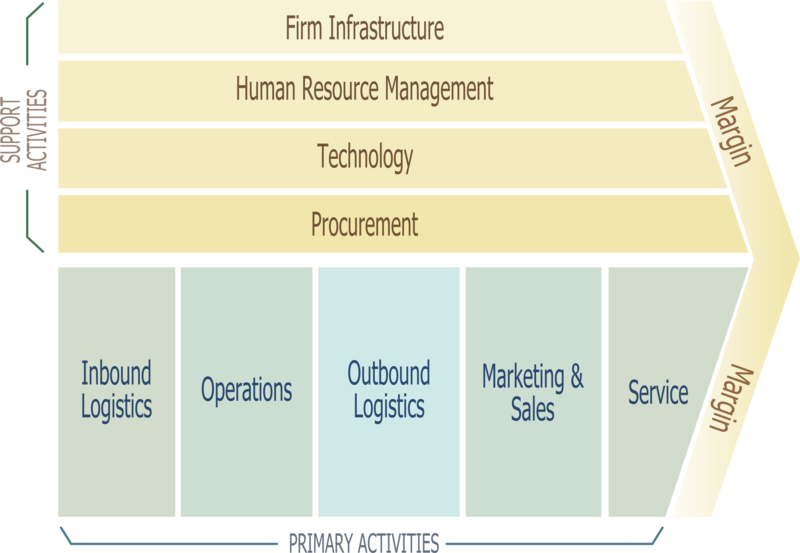
Porter Value Chain (from Wikipedia)
Working with clients face-to-face is always interesting and enlightening. However much a company may need help from a consultant in a specific area of their business, the consultant always learns a new way of looking at business problems. For me, a recent trip to a client led to many discussions about strategies for improving the business, both the little things and the big things. The big things, such as M&A and moving to a new headquarters, often have the greatest payback, but in terms of looking at the day to day operations of the business, looking at how a firm can improve its customer service quality while reducing wasteful activities can also pay back big.

During my visit, we started discussions about the value chain. We envisioned a long paper chart, pinned to the office wall, showing everything from prior to attracting a new prospective customer to the business, through serving them successfully and profitably, to finally ending the relationship and eventually dissolving that closed account completely. Its a compelling visual, since it touches so many pieces of the business, and can help business people who have become so entrenched in their piece of the puzzle to look around and see how their work impacts others, both positively and negatively. This long value chain / enterprise business process will make a great project for somebody, one day.

The issue I have whenever I look at the value chain, is that it is often viewed as a fairly linear and blocky thing, showing a flow of activities leading to value at the far end. Maybe this is just because many examples focus on manufacturing and the success of production lines. Of course outside of a production line, we all know that this linear view is just not the case. Activities go on in all areas of the business that deliver value, and different departments aren't always as remote from the action as the Porter Value Chain diagram (above) would suggest. Especially in services industries, I would suggest that we would end up with a series of segments of an orange all pointing in to value generation in the center. After all, it is hard to say whether a client will be more upset about a screw up in one group or another, when the financial outcome is about the same. In financial services, if a firm delays a wire transfer for $100k, or a rep delays placing a securities trade that increases the individual's risk, the actual cost may be small, but the perception from the client may be huge. Finance was responsible for one error, sales for the other, and only an orange slice view of the value chain puts them on equal footing. Reversing the view and delivering top quality service in both areas of the business may also deliver equal financial and value to the customer and then back to the business.

The issue with all of this is that the orange slice view of value does not help people understand the business processes that are being performed. It highlights that we are all one "big happy team", but in terms of understanding, it shows little else that is tangible to a business person. So the value chain can not replace business process definitions, which show the way work related specific transactions flow through the organization. And business processes rarely show where the valuable work is done in the organization, just showing where work gets done in an overall timeline. So my reminder to myself as a consultant is this: "just because I can make a business process work better, I must look at the value chain to understand where to focus my efforts". Nothing new, but a good reminder to all of us to get out out the weeds and look at the orange. And when things start getting a little too high-level-strategic with little focus, I can alway dive back to fixing specific business processes that I've now shown will deliver value to the business, and importantly its customers.

A post from the Improving It blog
Let us help you improve your business today. Visit www.consected.com
Monday, November 08, 2010

Advertise all you want, but what happens to the leads?

Advertising a small business's products is great, but the leads you get from your advertising investment are what matter. I spent a morning at the Javits Center in New York City last week, thankful to be out of the rain for a little while. One side of the building was taken over by the super-fit marathon runners preparing for a grueling 26 mile Sunday with some retail therapy buying fitness clothing. The other side was largely taken over by ad:tech, a chance for media channels, technology and ad buyers to uncomfortably mingle in one place. It is interesting that LinkedIn ads occupied a booth maybe 8 times the size of Microsoft advertising.

For me, where the rubber meets the road for advertising is when all that spending pays back and you get solid leads. The ad:tech presenters I heard were so overcome with excitement that you could count and measure these leads, slicing and dicing them in every way, that nobody seemed interested that you might actually want to follow up on those leads. You know, see if the leads are real, what the potential customer's need are, start building a rapport with the buyer. Nope, the most exciting thing apparently is drawing a pretty chart so you can optimize your advertising messages the next time.

So, you all shout, "just put the leads into Salesforce". Yeah, well how many small businesses have got through the learning curve of Salesforce to actually make it a useful system? In a quick poll I made, only one had finally invested the resources needed to get it to work. Even then, the leads coming in end up being entered laboriously by hand from the website. But hey, they can now get fancy reports to see how many leads are in the funnel. And it only costs $25 per user unless your are considered 'professional', in which case start considering how it will impact the kids' college funds.

Along the same lines, I have to relay the little chuckle I had when I walked past an expensive ad:tech expo stand (I won't name the company). The rep was talking to some interested people about the service he was touting. They asked for a copy of a case study, which he didn't have to hand. So what did he do? Scribble the person's email address on the back of one of his own business cards and promise to follow up. "But if you don't hear from me, do drop me an email to remind me", I heard him say. Yeah, lost cause I thought to myself - I wonder how many leads like that were wasted?

So, Salesforce takes some effort to get start on. If you already have it and are advertising to get some real leads, bite the bullet and work out if it really will work for you. I use my own software to capture lead information received face to face and on the web, through a simple contact web page powered by Consected. It gets the information directly into a lead workflow, helping us follow-up and track the responses. Fancy analytics, not so much, but to be honest I wouldn't know what to do with them even if they were there. It takes a company investing way more in marketing than we do to be able to really make use of that information.

If your company would like to improve how it captures and tracks its all important customer leads, contact us and I can help you get up and running in about an hour.


A post from the Improving It blog
Let us help you improve your business today. Visit www.consected.com

Wednesday, October 27, 2010

Fix the little things, and get big results

Workflows are just not big enough for us to pay attention to any more. Why bother fixing things that just involve a handful of people working to get a job done?!

Most business process practitioners experienced the days when a business process was represented in reality by a paper workflow. The movement of work from one person to another represented the process for specific work to get done, so we called it 'workflow'. The word workflow seems dated. Despite this, the paper workflow still exists, although in many cases the workflow has become email based, with just a piece of paper to be signed by the customer. 

Business process management, both methodology and technology decided along the way that it needed a bigger piece of the pie. If you just transfer work from one place to another, surely that's not very exciting. Every professional needs more than that. Let's make sure we can measure the process in a way that was never needed before, analyzing it to a level of detail that could be considered obsessive. Let's model a new improved process and simulate its inside workings so there are no surprises. Let's step it up another notch and implement the new process with tools that could run real-time stock trading.

None of this stuff is bad, just for many organizations (okay, all organizations), there are simple workflows that are run on paper or email. They don't need much analysis and they don't need simulation. They certainly don't need a 6-digit piece of software to run them. These workflows are common: accounts payable, check/cheque requisitions, complaints handling. Business process management wants to think big and be big. So nobody ever focuses on the fact that some of these processes have an impact through the value chain on customer satisfaction. 

So while we are trying to fix business processes at an enterprise level, don't forget fixing business processes, oh hell, call them what they are, WORKFLOWS, at the departmental and team level. Its amazing (although it shouldn't be) how picking off some of these smaller items can help a company be significantly more profitable through better customer service.

A post from the Improving It blog
Let us help you improve your business today. Visit www.consected.com

Tuesday, October 19, 2010

What? Not Collaboration?

Anybody who has read my posts for a while will know that I have big stretches where I post nothing. Looking back,you can see my blogging rate follows a pattern: it starts solidly, maintains itself well, before building a crescendo (of quantity or quality) and then fizzles out pretty fast to a long period of silence. Since I'm not communicating with the outside world through my blog, nobody will really know why this is. Well, its two word that don't really fit together neatly: "relationships" and "process".

Social networking and everything "Web" has tried to teach us that you can maintain meaningful relationships online, with people you've never met and are never likely to meet. That's fine, and I won't deny that there are names I recognize on screen that I have discussed matters with that I would never have known in a past life. I work from a home office, so I understand completely the importance of online communications. Hey, I even can enjoy chatting to people on the phone if its somebody I genuinely like. But its never quite the same as "face time".

This is why my blogging pattern is erratic. I work hard for clients because I like them, or grow to like them. But its like having a new best friend, it tends to exclude others for a while. Now with a client, the relationship is kinda weird - its a big love-fest with multiple people AND a project, all in a big boardroom. I suppose I'm a geek at heart. I enjoy technology and I enjoy seeing how businesses work. But I have come to realize what I enjoy from it is seeing how people respond to the technology and how they interact with each other to achieve their daily work. I genuinely want to make it better for everybody. That is why I like business process management. What? Not collaboration?

Business process management is great, as it addresses the fact that in business processes you are trying to force people to do what comes naturally to only a few: work together smoothly, efficiently and consistently in a fairly alien set of activities (if you are telling me that most of the work we do in offices is natural evolved behavior I'd probably not believe you, therefore its alien). If you can help people work in a structured way for work needing that structure, the end result can be quite impressive. I've seen customers' employees just glowing with excitement and happiness that so many of the stupid annoyance of their working lives have been removed. This isn't collaboration. Collaboration let's people do something that is natural (work together in unstructured interactions), doing it better when it comes to information sharing. Its great and useful, but its a different animal.

My reason for not blogging and chatting with some of you recently? I've been helping a client deliver three business improvement projects simultaneously. One is a big catalyst for many other business changes going forward. I have a relationship with the people around the project and the project itself. And when a just bit more process improvement is eeked out of it, I'll be very happy and blogging again with great gusto! My new best friend will have a great process. And great processes make everybody happy.


A post from the Improving It blog
Let us help you improve your business today. Visit www.consected.com

Friday, September 10, 2010

Processes need more than 2-D maps

Just in case you wondered why business process mapping fails us, here is a very short presentation (well, Prezi) to help me get my point across.
(If it doesn't start automatically after clicking, click More then Autoplay)


A post from the Improving It blog
Let us help you improve your business today. Visit www.consected.com

Wednesday, August 11, 2010

Business processes and the rear-view mirror


I have a growing appreciation of why certain financial institutions have got themselves into so much trouble. Attempting to manage a business, supervise minute-by-minute trading and review brokers' activities is hard enough, but its made even more challenging by the fact that many firms still attempt to do this by the human study of exception reports. I say 'study', because that's what it looks like: some very talented people picking through printed reports line by line, looking for patterns or anomalies. In some cases this is essential - a necessary step in what is being done is to review the past. But as the recent TV ad from IBM shows, and a range of software companies have hinted at in the past, running your business looking in the rear-view mirror is not only tricky, its downright dangerous.

So what do you do? Well, one approach is to take the printed exception reports and re-make them electronic. Keep them in a format where some clever software can supplement the clever people and look for the obvious patterns, based on predefined business rules, and the less obvious patterns, based on some seriously smart heuristics. But the rear-view mirror is still your issue. You are catching errors after its too late to do much about them - much beyond making a correction, apologizing heavily and reprimanding the employee that messed up. 

The second approach is to revert to the old days of decision making: a person makes the decision, but there is an approval process before any decision is actually executed. Great - its hard to screw up - and harder still to get anything done. For financial services that depend on the trading of smart, bullish individuals, running in near real-time, that just doesn't fly. But as the business rules management guys will tell us, even for less challenging environments than securities trading, automated business rules management is still not widespread enough in business. Why? Because for them to work as part of the whole, they need to be part of the overall business process. Not just tacked on the side where they can be bypassed easily, but fully embedded and completely enforced. And for that you need a system in place for managing the business processes in which the rules are enforced. A system for doing this is not email, its a real system that guides the correct flow of work, its delivery (between human beings, business rules and other systems). It doesn't have to be a multi-hundred thousand dollar BPMS / SOA / software vendor's ticket to paradise. But it does need to exist and start to become part of the workings of the business.

For now, making the rear-view mirror work better, while giving intelligent people more time to lift their heads and look ahead is my goal for clients. I will help them get to the next step when they have time to see the value of doing things differently.


A post from the Improving It blog