Showing posts with label financial services. Show all posts

Friday, March 18, 2011

Why Do Checks/Cheques Still Dominate B2B Payments in North America?

You have heard this theme from me before, and it was triggered again when I read a post on Finextra by Matthew Dragiff, "Why do checks still dominate B2B in NA?". In it, he suggests that IT and the need to develop a business case for a project such as electronic payments stops any change in its tracks:


The mantra, “do more with less” pervades today’s business climate, and companies increasingly struggle with how best to allocate limited resources so they have the most impact. The elimination (or reduction) of paper checks is perceived as requiring system changes for which a business case must be developed and funding approved long before projects can even be considered for the IT development roadmap.
My personal opinion that the paper check, and the vague attempt at electronic payments (by printing paper checks - ha!) needs to just go away. Despite this, I am never going to suggest doing a big expensive project without a good business case. This is nothing to do with today's business climate though. IT constraints have alway been a block on producing highly polished solutions in the US, compared to what I was familiar with in Europe. 


When I first arrived in the US to do professional services and sales engineering for an enterprise software company (8 years ago), I was surprised at the difference in the style of enterprise software implementation projects between the territories. I had the definite feeling that US companies were happy with "just good enough". This mostly translated into projects with a lot of rough edges, software that with little customization for the end users, and anything at the end of a business process (in this case check payment) being swept up by a mass of available labor.

The question was asked, "why would I pay for integration when humans could do the job more easily?". Fair enough. Its hard to get past that when you are building a business case, and it doesn't matter how many less quantifiable attributes you throw at the argument, like:

  • reduced risk of fraudulent payments
  • reduced risk of errors
  • easier tracking of payments within a full bank-reconciliation process
An ROI is an ROI, and there was definitely the view that automation was not needed around the edges of processes. And frankly the banks didn't make it much easier. With little option but complex sounding ACH / wire services, nobody but the specialists even considered it. And the cost per payment does not seem to be going down, and is still much higher today than using paper checks.

So, although Matthew says that ERP systems can handle this stuff easily, via middleman services, its not the cost of IT that is going to be the block, but the cost of paying your bank and a middleman for making each individual payment. Costs have been shifted, but they have not gone away.

A post from the Improving It blog

Let us help you improve your business today. Visit www.consected.com

Monday, December 13, 2010

Electronic payments - a cost of doing business for SMBs

An example of street markets accepting credit ...Image via Wikipedia
Electronic payments such as credit cards, debit cards and PayPal are outnumbering check payments in the US. Debit cards, counted the highest non-cash transactions, at 37.9 billion payments, while checks dropped significantly to 27.5 billion written in 2009. This is according to a short article in Financial Services Technology

This all sounds great for businesses, since electronic payments are so much easier to handle, receive and reconcile than checks. But electronic payments come at a cost. 2.9% of the transaction is what a small vendor will pay for merchant processing. Despite the efficiencies involved, this is a big chunk of change, especially if you are dealing in a small number of high value transactions. 

As check usage continues to plummet, and customers start to demand electronic payments from even small vendors, it seems that all the benefits sit with the consumer and the middle man processing the electronic payments. Eeking every efficiency possible out of the use of the electronic payment system is perhaps the only way that small vendors will be able to make up the gap. Process improvement in Accounts Receivable and Accounts Payable become essential areas to focus, especially as the paperwork burden to manage a 1099 for every vendor receiving over $600 in transactions in a year could come into effect.

If small businesses have recommendations of how they receive and pay for large transaction goods and services electronically, please leave a comment.


A post from the Improving It blog
Let us help you improve your business today. Visit www.consected.com

Tuesday, November 23, 2010

The value chain doesn't have to be linear

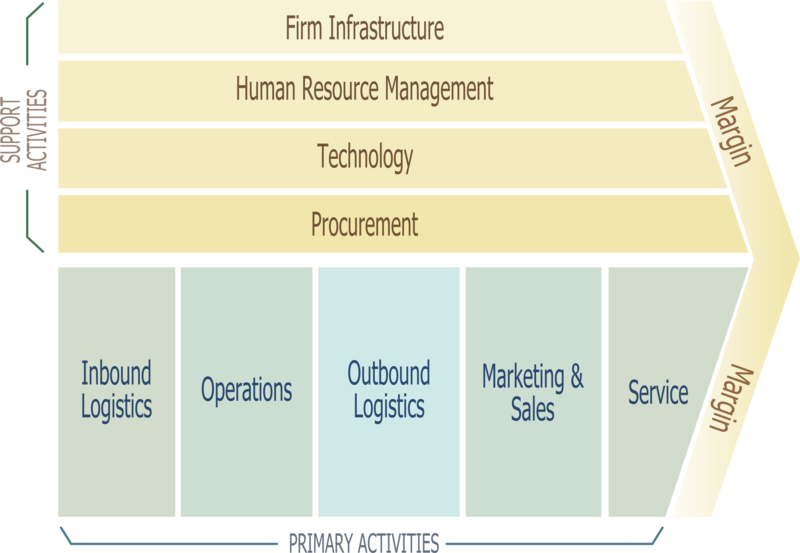
Porter Value Chain (from Wikipedia)
Working with clients face-to-face is always interesting and enlightening. However much a company may need help from a consultant in a specific area of their business, the consultant always learns a new way of looking at business problems. For me, a recent trip to a client led to many discussions about strategies for improving the business, both the little things and the big things. The big things, such as M&A and moving to a new headquarters, often have the greatest payback, but in terms of looking at the day to day operations of the business, looking at how a firm can improve its customer service quality while reducing wasteful activities can also pay back big.

During my visit, we started discussions about the value chain. We envisioned a long paper chart, pinned to the office wall, showing everything from prior to attracting a new prospective customer to the business, through serving them successfully and profitably, to finally ending the relationship and eventually dissolving that closed account completely. Its a compelling visual, since it touches so many pieces of the business, and can help business people who have become so entrenched in their piece of the puzzle to look around and see how their work impacts others, both positively and negatively. This long value chain / enterprise business process will make a great project for somebody, one day.

The issue I have whenever I look at the value chain, is that it is often viewed as a fairly linear and blocky thing, showing a flow of activities leading to value at the far end. Maybe this is just because many examples focus on manufacturing and the success of production lines. Of course outside of a production line, we all know that this linear view is just not the case. Activities go on in all areas of the business that deliver value, and different departments aren't always as remote from the action as the Porter Value Chain diagram (above) would suggest. Especially in services industries, I would suggest that we would end up with a series of segments of an orange all pointing in to value generation in the center. After all, it is hard to say whether a client will be more upset about a screw up in one group or another, when the financial outcome is about the same. In financial services, if a firm delays a wire transfer for $100k, or a rep delays placing a securities trade that increases the individual's risk, the actual cost may be small, but the perception from the client may be huge. Finance was responsible for one error, sales for the other, and only an orange slice view of the value chain puts them on equal footing. Reversing the view and delivering top quality service in both areas of the business may also deliver equal financial and value to the customer and then back to the business.

The issue with all of this is that the orange slice view of value does not help people understand the business processes that are being performed. It highlights that we are all one "big happy team", but in terms of understanding, it shows little else that is tangible to a business person. So the value chain can not replace business process definitions, which show the way work related specific transactions flow through the organization. And business processes rarely show where the valuable work is done in the organization, just showing where work gets done in an overall timeline. So my reminder to myself as a consultant is this: "just because I can make a business process work better, I must look at the value chain to understand where to focus my efforts". Nothing new, but a good reminder to all of us to get out out the weeds and look at the orange. And when things start getting a little too high-level-strategic with little focus, I can alway dive back to fixing specific business processes that I've now shown will deliver value to the business, and importantly its customers.

A post from the Improving It blog
Let us help you improve your business today. Visit www.consected.com

Tuesday, April 20, 2010

FinovateSpring 2010


I'm started to get excited for the Finovate Spring 2010 event in San Francisco. As the organizers put it:

On Tuesday May 11 in San Francisco, FinovateSpring 2010 will again showcase the most cutting-edge financial and banking technology innovations to Silicon Valley and the world.

With Finovate's signature mix of short, fast-paced onstage demos (no slides allowed) from handpicked companies and intimate networking time with their executives, this conference packs a ton of unique value into a single day.

The format of these type of events provides for a great energy. Great presenters, overstuffed on Red Bull and product hype put on a show that tries to appeal to the crowd and their specific target audience. And the audience gets a great opportunity to see what is hot in the financial services technology space.

The companies presenting are already putting a lot of time and effort into building the most compelling demonstrations, tuning their messages, and making sure that this investment in time converts to getting investors, customers and the press interested in their products.

For me, it is the range of products is what makes this event the most interesting. There are a bunch of electronic payment solutions, consumer focused sites for 'financial planning', and even some of the back-office systems providers. I am hoping to get the chance to chat to many of the presenters, while I attempt to blog live from the event (only if my brain and fingers decide to cooperate). So if you would like to catch up with me while I'm there, drop me a note.

If you are interested, the companies presenting are:


A post from the Improving It blog


Monday, March 15, 2010

Banking the unbanked

Image Source: Accredited Online
The banking system is not particularly popular with the common man or woman at the moment. Banking is seen as self-serving through the apparent desire to soak up rescue and recovery dollars by the billion, without doing what a majority of the population would like to see: drip feed some of that cash back to the people and small businesses that need it to survive. So when I read the WBJournal's story by Livia Gershon, about efforts to open the banking system to more low income people, I had to try hard to keep an open mind.

The western world is absolutely dependent on a healthy banking and financial services industry. The governments of the world outsourced (or maybe never really took control of) the infrastructure for handling money at the level of individuals, so the bail-outs that the banks benefited from are not surprising - without banks, we all suffer. The way that the bail-outs was sold to the taxpayers though does not fit what many are seeing in practice, with lending a flow of money as bad as ever. At the level of the unbanked (those who can not get a bank account or where it is financially impractical to do so), the problem is likely to seem irrelevant. If the banks don't appear to be handing out money, you probably don't care if you couldn't even get a bank account to put your money into.

According to the WBJournal story:

“We see people that are just still not using mainstream financial services, and they’re being taken advantage of in many ways,” he said.
In Massachusetts, 4.1 percent of households are unbanked and 11.4 percent are underbanked. Among households with incomes under $15,000, 24.8 percent are unbanked, and another 18.1 percent are underbanked. Nationally, 7.7 percent of all households are unbanked, and 17.9 percent are underbanked. The national numbers for households under $15,000 are 27.1 percent and 22.3 percent.

So, Massachusetts does better than the national average on persuading people that use of the mainstream system is better for them, but there are still huge numbers of people without access to those services. As a comparison, the United Kingdom, with a population of 61 million people shows 0.89 million individuals live in a household without access to a bank account. This equates to approximately 1.5%. This isn't about national competitiveness, just a number to help show that there is still room for improvement.

For banks to ever meet an acceptable level of social and local community responsibility in their provision of banking services to all there are several things that have to happen:
  1. Banks need flexible account opening procedures, to handle the less common cases, especially where an individual does not have a history of bank usage, or has unusual identity documentation
  2. In order to keep the costs to customers at close to zero, the efficiency of back office processes needs to be kept high, to keep transaction costs low
  3. A change in attitude may be required, to help banks see the new potential customers as a long term investment, rather than a burden they feel resentful of welcoming to their customer ranks
Quite frankly, #1 and #2 are easy to handle - with streamlined and well managed business processes that cut much of the waste and time-lags from a process, while ensuring the flexibility to handle complex cases. If a bank or credit union needs help understanding the opportunities here to help all customers, not just the unbanked, there are many resources on this blog that refer to business process management for account opening and financial transactions. Or feel free to contact me. Keeping costs down is not about cutting jobs; its about opening your available market to a broader set of people.

#3 is harder though. Attitudes can be changed in any business when appropriate information is made available. If it can be seen that in the long term, previously unbanked customers are responsible account users, and eventually become profitable borrowers through mortgages and loans, perhaps banks will be more likely to extend a welcoming hand. This is more likely to happen if banks have a full customer profile available, and can see that on average customers falling into this segment make decent business sense. Without information on the whole profile of a client, any business is likely to make rash decisions at an individual and group level.

I hope to see these numbers again in another twelve months and see the number of unbanked much lower.

A post from the Improving It blog
Let us help you improve your business today. Visit www.consected.com

Friday, February 26, 2010

Opening a business bank account takes a week. So what!

A survey by Finextra last year reports that:
For the majority of corporates, it takes more than one week to open a new bank account, according to a survey Finextra Research conducted over the summer. For this and other reasons, 44% of corporates say they would switch banks to get better service, standardisation and automation through electronic bank account management (eBAM) processes.
OK, so a week is a long time to perform such an important transaction, but really, do the survey's sponsors believe that the time it takes to open an account really is a driver for customers to switch banks? Once your in, your in. The time it takes for every other institution to open a new account is probably a block to you actually moving on. It seems to me that the headline is trying to push the point a little hard here.

When I opened my new business account (admittedly a small business not a mega-corporation, but I bet they are a large volume of what banks are dealing with), Bank of America had the account open in about 60 minutes. It was a painful process to watch, but it worked. From my blog about the experience:
The issue for me is that the systems that agents must use to set up accounts appear not to be at all customized to the type of account or the needs of the branch agent. It appears to be true that agents and brokers in financial institutions are limited in the types of accounts they can open less by the skills they have selling an appropriate product to a customer or being licensed to sell what is available, but in fact in the amount of training they have in the account opening systems. In all, it took me an hour to open the account. The agent was friendly and helpful, but how few customers can she help in a day if the systems force her to work at that rate?

The survey from Finextra doesn't reflect my experience, even if I do believe that many organizations could do a lot better at account opening.

A post from the Improving It blog

Let us help you improve your business today. Visit www.consected.com