Thursday, March 17, 2011

My website wants to be the "belle of the ball"

Design, when applied to fashion, includes cons...Image via Wikipedia
Am I an amazing website designer? No. Do I know a great website when I see one? I think so. The challenge I have when designing a website is not getting carried away and trying to copy the slickly designed sites that are intended to show how great the designer behind the scenes is at design, rather than providing a clean website packed with useful information for my customers, prospects and random Googlers. As I balance a desire to produce a slicker website, I constantly have to remind myself why it is there. And that in itself opens up quite a can of worms. Why is the website there? What is the point of the business it is representing? Can this thing be beautiful and functional?

As a small business owner, I have the self-imposed responsibility for the company website. I'm quite comfortable with this, despite it being horribly time consuming. If I can spend the time to verbalize what I think the company offers customers on the website, then I'm in a better position to talk about it with prospects and partners. It reflects what I alway knew about the best software salespeople I worked with in a previous life as a product manager -- the best of the best could understand enough of the technology to talk lucidly with customers about what they were selling. They didn't just walk in the door with shiny shoes, a big smile and hand over the show to the sales engineer to do the talking. If I can write decent copy for the website, I understand what is being sold well enough and what value it offers the customer. If I end up in technical jargon, or marketing fluff, then I need to think a bit more. Yes, I do regularly go back and read what I have written. Then I add it to the to-do list to fix up later.

So a website now has great content, an aesthetic appeal to match what it is selling. What more is there? If the website has the potential to be the  "belle of the ball", but never stops staring at itself in the mirror, then nobody is going to notice it. Twitter, Facebook, whatever other social media tools are all very nice, if you can generate a credible number of real friends. But as I've seen from my own website stats, a little paid advertising can go a very long way! 

My one rule of websites: flaunt what you have, then when people talk about how beautiful you are you can stun them with your depth of knowledge too.

(It seems that this blog and the Consected website still need a little cosmetic work!)

A post from the Improving It blog
Let us help you improve your business today. Visit www.consected.com
Enhanced by Zemanta

Tuesday, March 15, 2011

Strategic thinking in the "Browser Wars"?

Main logo and icon for the open source interne...Image via Wikipedia
Web browsers have started to develop again really quickly. Cloud computing, so central to the marketing from the biggest technology players, relies on fast, well designed browsers. So the "Browser Wars", the fight for dominance between Microsoft's Internet Explorer and Mozilla' Firefox is becoming interesting again. Largely because Google threw in a little flare a while ago to light things up, in the form of Chrome. Believe it or not, this really does matter to businesses, large and small, not just teenagers browsing dubious websites. With three big releases from the big browser players with us, we can start to see how the whole PC market is going to shape out. Yes really.

Taking a look at the article in CIO, Five Changes CIOs Should Care About, and you'll get a good idea of the importance Microsoft is placing on the newest release of its browser. Browser design, in my opinion prompted by Google Chrome's minimalist view of the world (you have one text box and a button for everything) has started to realize that people are most interested in the application that is running inside the browser, not the fluff and toolbar buttons around the edge. Looking at the official IE9 website, it shows the browser with a minimalistic frame around the website, a bigger Back button a large address bar and some tabs:
Simplified yet enhanced, the user interface brings sites forward. Characteristics of each website are reflected throughout the browser, allowing you to be more immersed in each site you visit.
Great, so the browser has been designed down to what it should always have been - a container for showing websites, not a flashy application that distracts and makes browsing or application use harder. So, what's the big deal?

Browsers have got faster. Much faster. And this matters for the growing adoption of cloud based applications. Google Chrome pushed the envelope, and gained a significant market share for three reasons: 

  1. it looked good
  2. it worked fast
  3. it was secure

I used to use Firefox. It was starting to get bogged down under its own weight, and not managing the load of modern websites and software as a service (SaaS) / cloud-based applications. So I tried Chrome and never looked back. Internet Explorer has been slowing down for years, as the Microsoft teams placed little relevance on the importance of the browser. But if Google can make the browser the primary operating interface for all applications (since all your apps are apparently moving into the cloud and off the desktop), then that starts to make the Windows operating system irrelevant and largely an unnecessary expense for most PCs. So it was time for IE to fight back. And this is where the Browser Wars strategy seems to get confused.

IE9 is fast. In some tests it is faster than the newest release of Google Chrome 10, and likely to be faster than the much delayed Firefox 4. They are all fast compared to IE8 though. This is great news for everybody. No matter which browser you choose, your browsing experience has just got hugely faster on the slickest websites (and trust me, that makes it much more enjoyable to use sites with smooth transitions, images that fade in and out, menus that do clever things, etc). You are starting to use some of the power of your PC hardware again. 

But then we come to that "strategy" topic. Microsoft have decided that IE9 will only run on Windows 7 and Vista. XP is dead in the water. Why would they do this? Well, cost is the primary reason. Its easier to develop and support for two versions of Windows, rather than three. Then there is the fact that Microsoft must be acknowledging that the browser really is making Windows irrelevant. If they give you a great browser (for free remember) on XP, why would you ever buy Windows 7? This is where I find the strategy to be flawed.

If the browser is so important to the OS (and you'll remember that Microsoft ended up losing a lot of money in the European courts for tying IE and Media Player to Windows to try and destroy the competition), then I'm not going to upgrade from XP to Windows 7 just so I can use a fully featured browser with the latest security. Oh no, I'm going to install Firefox 4 or Chrome 10. Microsoft loses more market share with the older OS users. The users come to realize that they really don't use that annoying Windows stuff behind the scenes, their browsing experience just got better without a new PC, and the next time they come to upgrade they buy the absolute cheapest edition of Windows they can possibly find (you can't get a PC without Windows pre-installed, so you'll have to suck up the Microsoft tax). And they'll install the same browser they've been using for the last 18 months, which will not be IE.

So, cost aside, Microsoft is basically telling people with older versions of Windows to go and try a competitors browser until they upgrade their PC next. But then Microsoft doesn't really care about that mass of users. They want the bigger slice of the pie, the CIO and his or her re-growing IT budget. Which is just a shame, as the next big companies (those growing from SMB to Enterprise status) will be using Google Apps or Zoho in a Google browser, not Windows, Office and IE.

Whatever happens, I'm happy to have faster, prettier, more secure browsing. Even better that I don't need to worry about botched Windows releases anymore!

A post from the Improving It blog
Let us help you improve your business today. Visit www.consected.com
Enhanced by Zemanta

Tuesday, March 08, 2011

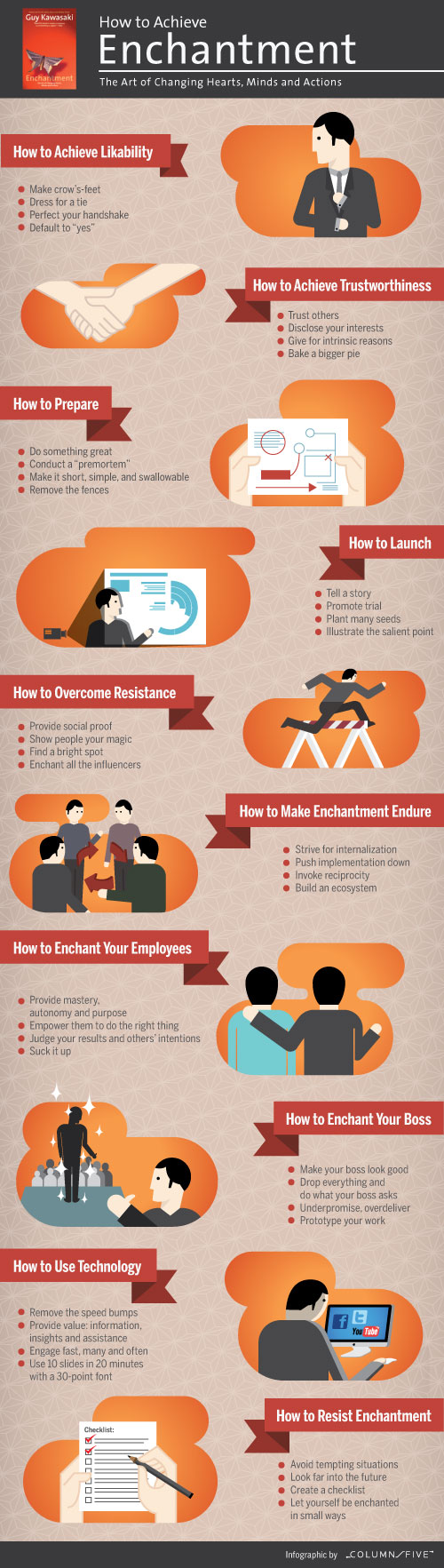
Enchantment - its as much about 'you' as it is your business

By now you must have heard that Guy Kawasaki, the master of Mac marketing has just released a new book. Enchantment covers every tool marketers, sales and even customer services people have available to them to individually and collectively enchant customers. I've written my impressions of the book, and even have a Q&A direct from the mouth (well really keyboard) of the master himself, so read on!

(On a mobile device? Click to read the mobile version.)

The big question the book addresses is "why enchant customers?". The answer, obvious to the social media generation maybe is because they advocate your products and your brand, buy more and persuade others to buy more. Enchanted customers, as Kawasaki explains with multiple examples, are a powerful force, and are way more valuable to a brand's success than the "rich, famous, and traditional influential people", the media superpowers such as himself. After all, if I can be a blogger, anybody can be a blogger, and many (most) of you are going to be a hell of a lot more influential than me. When you add all those voices together, if you can get them to talk about you, many more people are going to hear, believe what they are hearing, and will subsequently buy what they are hearing about. In Kawasaki's words "Nobodies are the new somebodies in a world of wide-open communications".

The book has been described by several reviewers as the "How to Win Friends and Influence People" for the 21st century, and even before I read the other reviews (or even the back of the beautiful book cover) I was coming to the same conclusion. There is a lot written about how you, as an individual can affect people's perceptions of you personally, and therefore the brand you represent. I wasn't reading this as enchantment (initially), just how to be a better salesman and not piss people off. As I read on though, it starts to fall into place. If you are an insincere or bad person, you are going to struggle with enchanting customers and might as well stick with conning them into buying your junk using your current devious tactics. Kawasaki reinforces the importance of being good and not confusing successfully 'selling' with 'enchanting' several times as the chapters progress. He even has a fun online test to see how enchanting you are.

An interesting theme that I found challenging in the book was around building an ecosystem around your product. I understand this is hard, and a great point that Kawasaki makes is that for an ecosystem to work, you have to create something that is worthy of that ecosystem. You need a great cause, and if you have it the ecosystem will probably grow itself. The challenge for me out of this, and many small and mid-sized businesses is providing one thing that can be identified as good enough to warrant and ecosystem, and identifying enough like minded people who can seed it. The ecosystem starts to be a realistic concept when you already have some success. I was going slow when I read this, as I kept trying to understand how a startup with five paying customers can develop and ecosystem. The book is targeted at all phases of a lifecycle of a company, and this part just happens to be down the path from where many of us are now.

So, the really good bit of this post is the stuff that you won't read in the book. A really quick Q&A. Questions are from yours truly. Answers are from the master of enchantment, Guy Kawasaki.

PA. Enchantment sounds like a wonderful goal for big brands (and there are many big names [in the book] to back it up). But what about the small businesses growing from the ground up? What is the most important thing a small business owner can learn from the book?

GK. Enchantment isn't a big, expensive, "hire a consultant to get it done" activity. Not at all. In fact, those qualities are the enemy of enchantment. The bottom line is that a small business should employ people who are likable and trustworthy, and it should sell a great product or service. Money isn't the gating item. The hard part is realizing that there is a better way to do business, and the flexibility to give it a try.

PA. The enchanting experiences require us to think differently and interact with customers differently. Is this just a change in the way we educate employees, or do we need to fundamentally change the nuts and bolts processes that businesses run to allow this to happen?

GK. There is a causative relationship: if you educate employees and empower them to enchant customers then, quite naturally, they will change the nuts and bolts processes of the business. Management, however, has to believe in enchanting customers. My recommendation is that instead of announcing a great enchantment campaign ("Oh God, the boss read another book..."), management should start with small things. Stuff like answering email faster or returning all customer phone calls. Take it a step at a time and build upon success.

PA. Working with customers in an enchanting way sounds like it is extremely time consuming and probably quite costly. Are there any short cuts a small business can take?

GK. Quite the contrary, enchantment is not time consuming and costly. How much more does it cost to smile, dress appropriately, and give a good handshake? And to act in honest and trustworthy ways. "Shortcuts" is a loaded word. I don't recommend shortcuts that amount to putting lipstick on a pig. But the foundation of enchantment is not hard or costly. It's just different. 


As you can see from just the answers here, there is a lot for small and mid-sized businesses in Enchantment. And it comes down to personal commitment and presentation, as much as complex organizational changes and expensive marketing campaigns. We think the same it seems: simple changes to the way a business works can have profound effects.


Enchantment Infographic


A post from the Improving It blog
Let us help you improve your business today. Visit www.consected.com

Friday, March 04, 2011

Do mid-sized businesses have money to burn?

Windows mobileImage via WikipediaIts interesting that as soon as a company grows large enough to fill more than a shared services office space, they consider themselves big enough to throw money around like crazy. I offered my thoughts to reporter writing a story about how small and mid-sized businesses could save money in the IT department, and realized that many small businesses are way ahead of their bigger cousins in terms of working more cost effectively -- without losing anything in the way they work.


Since I didn't hear anything from my pitch to the reporter, I'm going to share this information with you. You'll look and say, "of course - that's ridiculously obvious", but really how many mid-sized businesses have taken the plunge into saving money rather than being trapped in overpriced 20th century technology? Bear in mind also that I have 15 years experience around software, so if you know how to manipulate Dell for a better offer, let us know! (I go to NewEgg for my hardware requirements - they offer small name PCs cheaper that work just as well as the big names).


  1. Productivity Suite: Use Google Apps as a replacement for Microsoft Office. It is significantly cheaper, especially considering how small a piece of the functionality of Office most people use.
  2. Dump Windows: Now that you have a friendly Office productivity apps in place, start using Linux on your new desktop and laptop PCs, when it comes time to replace them. Nobody is going to complain, since they are doing most of their work in a browser, and Ubuntu (my OS of choice) is as clean and simple to use as any Windows 7 machine for all the remaining desktop tasks a user may have. And with that, you save on buying licenses for resource and wallet hungry virus scanners.
  3. Save it to the Cloud: Install and maintain complex and expensive network attached storage? Why bother, when cloud-based storage is cheap, flexible and saves you not only hardware, but the hassle of backups too.
  4. Need Windows for Quickbooks? Some business applications just haven't been made workable in the cloud - Intuit's offering is an example where some users will still need Windows to install some real software. So consider using virtual machines with Windows installed to run them. Why? Because the next time you have to replace the hardware, you don't need to buy yet another license for an OS you already own.
  5. Work Better! All of this has been about saving costs for IT. How about giving back to the business a little? After all, its the reason IT exists. Encourage the use of process, content and collaboration tools that will help people work better, share information better and save emailing every document they work on backwards and forward a hundred times.
Let me know your tips that we can all use to work cheaper and better.  

A post from the Improving It blog
Let us help you improve your business today. Visit www.consected.com

Thursday, March 03, 2011

Not great customer service

We all say that providing great customer service is important to us and our businesses, but how many of us really mean it? Sometimes words and actions just don't align, and I have what I consider a great example. Ready for a short rant? Read on! 

I use a Citibank credit card, so I can collect airline miles for occasional trips to go and see the family in London, and its been fine. How hard can it be? I buy things, pay the bill and Citi credits me with some miles. So this week (despite the date of February 18th) I received this letter, which in summary (and jest) said:
On January 1st, you tried to buy some flowers for you mother's birthday. We rejected your card a bunch of times. You assumed it was the fault of the vendor, as their site stopped accepting any card you owned. That's probably because we were providing merchant card services for them too. Though you can only guess at that. Anyway, almost two months later we are going to remind you of this bad experience and give you vague assurances that it won't happen again. Love and kisses, the CEO (who will claim he never even saw this letter if it comes down to it).
Now, thanks for reminding me of an unfortunate experience with your credit card, which I could have just assumed was somebody else's issue. Doing so, so long after the event is just crazy in my opinion. I'd forgotten about it long ago, and have been frankly more irritated by the incessant calling from your India based sales reps trying to sell me fraud detection services I don't want (to the point that I will dump the card if I see that Citi telemarketing call pop up on caller ID once more this month). Though you kindly reminded me that you can't be trusted to run a decent service, and that I'll receive more calls from Sales than for any useful customer services. And if you are going to send me a really personalized letter (wow - it addresses me by my full name), at least make it sound personal. That letter must have taken at least two minutes less than the time it took me to write this blog post (including the time to get it reviewed by Legal). Maybe you could learn something from my discussion of aligning employee development with business process improvement. You might get a meaningful letter out in a timely manner.


Sorry Citi, but you have no idea how bad the perception of your customers is over annoying telemarketing, and misjudged customer service like this (or maybe you don't care). I am not looking forward to the day when you screw up my bill or block my card due to "fraud detection" and I have to actually try and speak to somebody real to get it fixed. I think on that day all my eggs will be in one basket with Bank of America, who provide me really good service. If you would like me to help with an assessment of why this letter irritated me so badly, and whether other customers feel the same, just give me a call. I'm sure you have my phone number on file as your sales reps are going to wear it out.


A post from the Improving It blog
Let us help you improve your business today. Visit www.consected.com

Tuesday, February 22, 2011

Your phone: pay for more (but not in the usual way)

First 4 digits of a credit cardImage via Wikipedia
So you already think that your mobile phone can do everything? There's an app for this, an app for that, we can email photos taken by pinhole-sized phone cameras, and we can all wonder how its possible for an average teen to walk and text simultaneously. So are you ready to pay for more with your phone? And for once I don't mean this the same as 'pay more', I mean pay for more things, as you would get cash out of your pocket to buy a can of Coke from a vending machine.

FloridaToday.com talks about the rise of contactless payment technology (thanks to Bob Wieseneck at Applied-InfoSystems for sending me this story). It seems that this long discussed, and usually ignored function that has been so popular in Japan, and almost completely ignored in the rest of the cell-phone using world might be gaining popularity.

An interesting stat from the article:
The Smart Card Alliance estimates that there are half a million contactless terminals in the U.S., in 150,000 to 200,000 locations. That compares to perhaps 6 million locations in the U.S. with traditional card readers
Many of these terminals are in New York city taxis, which have the contactless NFC chips. This in my opinion is an ideal location for contactless technology. When in a cab I'm more likely to have easy access to my phone, or its already in my hand. I don't need to grope for my wallet in the dark, dropping $20 bills and my house key on the floor, when I can just tap the phone against the reader and I'm done. Better for the driver, better for me. Its the same anywhere I don't want to be troubled or risk taking my wallet out and flashing the cash and cards. I want to buy a Coke from a vending machine on a busy subway station? Tap and go. The same for parking meters. The benefit is not just speed, it is convenience and security as well.

An interesting point comes when you consider, according to the article:
In stores, phones with NFC could be popular if they do more than merely replace a wallet of credit and debit cards. They could help merchants track and reward loyal customers, replacing both loyalty cards and printed coupons.
What is it that allows stores to do this? Well, the stores are a little restricted with what they can do with your credit card number, and what you will allow your credit card to do (if I can buy thousands of dollars of stuff with a card, you guys aren't getting my permission to mess with it!). The technology and security around credit cards limits the information stores can collect and use at the point of sale. After all, its just a number, and your data and preferences are very separate. Outside the US, chip and pin credit cards have shown the security and anti-fraud benefits of getting away from a swiped card number.

With contactless technology, the stores aren't bound by Visa, Mastercard, Amex or the consumer's perception in the same way. If they can get your permission to use your contactless device to act as a loyalty card and payment card in one, then they start to get some interesting applications. It seems that the humble 2-D barcode I've been chasing for tracking consumer preferences could have a run for its money. You may now have an option: scan or tap to find out more about that enticing offer on the shelves of the local retailer?

I'm ready to pay for more with my phone. And maybe this technology will be led by smaller businesses as they upgrade their point of sale equipment a bit at a time. The large corporate retailers may be too slow to catch up given a need for standardization and mass rollouts of new card payment machines. This could mean that the little guy has a better chance of catching this wave of adoption of contactless payment technology by consumers.

A post from the Improving It blog
Let us help you improve your business today. Visit www.consected.com
Enhanced by Zemanta

Wednesday, February 16, 2011

CRM made meaningful AND easy?

Small business does not need enterprise software (because it sucks) is a post I wrote just a couple of weeks ago. And CRM is one of those Big Enterprise systems that just screams "spend hundreds of thousands in consulting to implement me!". Even Salesforce doesn't make it particularly easy for small businesses that just want to manage their clients, prospects and contacts. Getting started is just too hard. Well, it seems that things might be changing. Just a few minutes ago, TechCrunch put out the story that Constant Contact Buys Social CRM Startup Bantam Live for $15 Million in Cash. For any of you who have been reading about my exploits getting my first email newsletter out to my contacts using Constant Contact, you'll know that I love what they do (and you may also remember that my wife works for them - I have not been rewarded for writing this). So I'm interested in how this new addition of Bantam Live to the Constant Contact suite will help small businesses to really know who they know.

I'm sure that Constant Contact are downplaying what this acquisition means right now. Sure, when I looked at Bantam Live during some research for my own efforts with Consected, just a couple of months ago, I would say that ease of use and fast start for getting contacts into the solution from numerous sources (including your social media contacts like Twitter) was appealing. And this is going to be considerably better than the sufficient email contact upload capability Constant Contact has available currently. But my hope is that you smart guys at Constant Contact are thinking about this more broadly. What do I mean? Well, as I have your attention, here is what I, as a small business owner want...

Just remember, as a small business owner I don't want to be looking in multiple places for customer contact information. So the CRM capability needs to really live up to the C in CRM - 'Customer'. Not just another contact I can engage through your email, event and social media marketing. But a true customer who is spending money with my business, and therefore sometimes contacts me about stuff. I need to know their history, know the key contacts, even mark some of them as 'do not send marketing emails', so that I can truly manage the customer relationship. And it all needs to just be there, up and running and configured when I first login. I don't have time, or energy to work out how to get it configured or choose from lots of options - it just has to work - now. 

It is around the true management of customers that I hope the really solid features of Bantam Live live on. Easy to use social CRM will certainly help me in the engagement of my contacts, not just through email. But the collaboration and task management capabilities seem to allow the opportunity to offer more of a small business suite than mere email marketing alone. I'm bullish about this for one reason - Constant Contact has proven to hundreds of thousands of other paying customers that they can make previously complex technology accessible to users who rarely venture away from their Yahoo home page. If they can do this with the Bantam Live CRM + collaboration capabilities, then I think they are on to a winner and will be loved by more and more small businesses, for more than email newsletters.

A post from the Improving It blog
Let us help you improve your business today. Visit www.consected.com
Enhanced by Zemanta

Tuesday, February 15, 2011

Why are we afraid of accounting processes?

office of Jacob Fugger; with his main-accounta...Image via Wikipedia
I didn't question it too deeply when I was a product manager for an enterprise Business Process Management (BPM) software firm, although it was always there nagging at me: why don't we do more work with accounting systems and the Finance team in general? They are core to the running of a business, but BPM (at least the stuff I worked with) generally tries to avoid those types of business problems. Looking back on it I think there are two easy reasons. But before I get to them, I'll repeat to myself and others the justification that always came out from the marketing team's collective mouths:
Our solution, ExeClassyProcess720 (made up name, and now waaay uncool as any teen snowboarder will tell you - since everyone is landing 1080's now) focuses on the bigger business problems. You know, like the ones that address the customer facing transactions which when done consistently well help companies attract new clients and make current clients more profitable and happier. That back-office stuff doesn't interest us because that involves working with accountants, and they never have any money to spend.
That's a fictional description of how enterprise BPM justifies any particular niche it works within. The real issue is not the first piece of the discussion, which may be a very realistic way of positioning an individual product if that's where its strengths are. But it is the second piece that really gets to the meat of the matter: it is perceived that any team that reports to the CFO is unlikely to have any money to spend on improving how they work. Is it really true? After all, Oracle seems to do a pretty good job making money out of businesses requiring Financials packages and all the related modules.

So BPM software vendors go the easy way - they look for the obvious issues that they can solve, then when they run out of the easy stuff they get stuck. So during a vendor's decline, it goes down justifying to itself why it can't address the thousands of other process problems that appear in a business, because the mind-set is still locked in the "can't go near the Finance team" mode.

Back to my two easy reasons why BPM avoids anything that has accounting software related to it:
  1. BPM'ers are scared of accountants as we don't know their business
  2. BPM doesn't play well with other software, despite all the hype

Why are BPM'ers afraid of accountants? We've been pretending we know or can learn other people's business better than them for years, so why can't we raise the same level of BS with accounting? Probably because the numbers don't lie, whereas there is such a lack of formal measurement in other parts of the business that its easy to "bluff it and hope" when fixing some of those other business problems. 

The reality is that accounting packages really don't address well many of the inputs and outputs related to the financial running of the business and could really do with some help. I'm thinking of travel expense reports, accounts payable invoice handling, and even the financial planning and forecasting process. These are ripe opportunities that any BPM'er could address, if they could get over their allergy associated with accounting.

The fundamental issue I think is that enterprise BPM is put off by the fact that an accounting system exists and is the guardian of its data. Business processes can only touch that data, feeding it, watching it for an hour or two like a good aunt or uncle, but always returning it safely and soundly to the watchful accounting system when its time is up. Despite all the 'web services' hype, BPM tends to be greedy. It wants to consume that data, chomping on those healthy numbers and mixing it with its diet of junk food data from operational processes. If it really can regurgitate those numbers in any useful form, they needs some really good cleaning up before returning them home.

Despite the rather gruesome imagery, BPM just doesn't play well with others. The accountants that BPM'ers are afraid of will make them look dumb, and the data that those accountants so carefully enter into the accounting system are just too pristine to mess with in a BPM solution. So BPM software and practitioners back off, and wonder why the big consulting firms just get bigger. 

For small firms like Consected this is great. It leaves plenty of room for financial management systems, ERP, and big consulting firms to do such a bad job that eventually the CFO will recommend some new investment in technology, with a proven ROI (imagine that in other parts of the business). At that point the non-BPM crowd get their chance to show that business processes can be made better where there is an accounting system and that we can all play well together.

A post from the Improving It blog
Let us help you improve your business today. Visit www.consected.com
Enhanced by Zemanta

Thursday, February 03, 2011

Email marketing - it really works!

I've been talking about my experiences with email marketing, after my wife who works for Constant Contact persuaded me to give it a go. The main effort I have been putting into it is providing subscribers of my newsletter (mostly Consected customers) with valuable information that they want to receive in their inbox, not just another spammy sales effort. Well, it has finally come together. I sent out my first newsletter to a test group of 99 email addresses on Tuesday. Why 99? Well the free-trial from Constant Contact limits you to a small list of contacts initially. But this set was plenty for me to start to see the response. And I can say that based on this I have already signed up for the real service! That represents a high recommendation for the service, trust me.

Following some advice from the expert on communications, my wife, to go with a single topic for the newsletter, I managed to pull together some pretty good content. It followed my current area of interest, barcodes, and how they can help business organize information better. For those of you interested in seeing the newsletter, and the demo it contains, take a look at the archived copy: Can you improve your business with hundreds of little dots?

What kind of feedback did I get? Well, the Constant Contact reports are nice. They report email opens, link click-through, and other useful stuff. I signed up because I was amazed to see that the email was opened by more than 30% of recipients on the list. That means that 30 people at least opened the email to see what it was talking about, rather than just hitting delete. A couple registered 'do no mail', which is good to know. But frankly I messed up on the click tracking, as I disabled it in a few important links, so the Constant Contact reports don't give me that information and I have to hunt around elsewhere for it. And quite honestly, my cheapie website host kept putting my shared server offline the day the email went out, so many people wouldn't have got to the website anyway. I see a move to the Consected production Rackspace servers in my crystal ball.

But I went one better than the great open rate. After seeing the newsletter, a business partner I hadn't spoken to in months contacted me -- with a great new business opportunity! That will be worth the effort and monthly subscription fee without doubt!

I'm going to follow the same format for my next newsletter, in early March. If I get the same rate of response I'll be stunned (and happy)!


A post from the Improving It blog
Let us help you improve your business today. Visit www.consected.com

Thursday, January 27, 2011

Small business does not need enterprise software (because it sucks)

Graph of typical Operating System placement on...Image via Wikipedia
I've been getting really involved in applications for small and medium-sized businesses (SMB) over the last few months. And a constant eye opener for me is the importance of making business applications as simple and intuitive as feasibly possible, while retaining a huge number of options and configurations to fit every need. Why is it an eye opener? I suppose I had never needed to consider the usability of software that could be used by a regular consumer -- the enterprise software space is different. Again, I ask myself why?

It seems to me that enterprise software has things easy when it comes to usability for end users. The natural assumption is that the software is complex, and that large companies will invest extra in training their workers to use a new system. The fact is that enterprise software is complex, but at a technical level. The problem is that the technical pieces of the software tend to show through the cracks in the user interface, leading to strange ways of working and difficult memory tests for end users as they try and remember what they have to do next to get their tasks done. 

SMB software is often technically simpler for the simple reason that it hasn't been growing for 20 years, through a range of technology trends and software languages. It tends to have less churn to deal with, so the complexity of its functionality doesn't have to compete with the complexity of the code that makes it run. SMB software and especially newer software as a service (SaaS) products can spend more time considering how the end user needs to use the system.

So there are no real surprises. Enterprise software has become lazy, and IT buyers who are rightly most interested in the technology that makes it run help perpetuate this laziness. Enterprise software can focus on tech buzzwords, not usability. My challenge for today is how to make an application so blindingly simple that a user logging in and using it for the first time knows exactly what to do, without hiding the options that allow it to be used by more than 0.0001% of companies that might want to use it.

A post from the Improving It blog
Let us help you improve your business today. Visit www.consected.com