Showing posts with label small business. Show all posts

Monday, September 12, 2011

Being mobile is having a location

Location matters, even online. We are social creatures. We love interaction with real people. We don't just "like", we love people that we have conversations with (even on Twitter and Facebook). This human nature extends to "being local". It is not just for reducing a carbon footprint that people are interested in local businesses. We like our communities, and we love the businesses that serve them well. Yeah, we can all jump in the car and drive for an hour to the big box store. But there is a warm feeling that comes from chatting to a local shop owner before buying something, then stopping for a coffee at the local cafe, or a pint at the pub. So how on earth does this work when you are online?

It is alright to have an online personality. OK, its better than alright, it is essential, if you want to be part of the social media conversations that people crave. So if you have a personality online, why can't you have a location too? Everybody recognizes that your presence is faked if you appear to be online 24 hours a day. Instead you are somebody real if you are in a location that finally recognized it was time for the sun to set and you to go offline. That is only one way to have the appearance of "location". If you truly are a local business, one that requires people to inhale the aroma of your coffee as they sit and enjoy sipping it, or discussing the merits of this widget over that one when fixing a blocked drain, then you need to go a step or two further. 

As a local business, having a website is essential, even though 99.999% of the world's population will find it irrelevant. But you do want your online presence to be relevant to 100% of your local population and visitors who might want to make use of your services. For this, your website needs to do three things:

1) help people find you
2) help people learn more about how you can help them
3) help people remember you

Maybe you'll be surprised that being local to people online is easy. In fact, you can be closer to potential customers than perhaps you would like to be in reality: nestled in their pockets and purses. Yep, you need to be on the smartphone that people resort to when they didn't plan well enough before leaving the house so they can find your address, in Google mobile search results when they are looking for a place for lunch, or finding out how to fix that blocked drain from somebody who knows. Being mobile is having a location close to your customers, whether they search for you or scan your local newspaper ad with a QR Code. Having a website just isn't enough.

With a mobile friendly website, people can find you when they are close to you and ready to buy (there are some trick to this that make it work even better). They can learn what you have to offer when they have found you. And if you are smart they can remember you by a quick click to Like their Facebook page, follow them on Twitter or join your email newsletter. Because the best customer is the one who is local and comes back again and again. Being mobile gives your location and online personality a meaning, and gets you more of the best customers.


A post from the Improving It blog
Let us help you improve your business today. Visit www.consected.com

Thursday, March 17, 2011

My website wants to be the "belle of the ball"

Design, when applied to fashion, includes cons...Image via Wikipedia
Am I an amazing website designer? No. Do I know a great website when I see one? I think so. The challenge I have when designing a website is not getting carried away and trying to copy the slickly designed sites that are intended to show how great the designer behind the scenes is at design, rather than providing a clean website packed with useful information for my customers, prospects and random Googlers. As I balance a desire to produce a slicker website, I constantly have to remind myself why it is there. And that in itself opens up quite a can of worms. Why is the website there? What is the point of the business it is representing? Can this thing be beautiful and functional?

As a small business owner, I have the self-imposed responsibility for the company website. I'm quite comfortable with this, despite it being horribly time consuming. If I can spend the time to verbalize what I think the company offers customers on the website, then I'm in a better position to talk about it with prospects and partners. It reflects what I alway knew about the best software salespeople I worked with in a previous life as a product manager -- the best of the best could understand enough of the technology to talk lucidly with customers about what they were selling. They didn't just walk in the door with shiny shoes, a big smile and hand over the show to the sales engineer to do the talking. If I can write decent copy for the website, I understand what is being sold well enough and what value it offers the customer. If I end up in technical jargon, or marketing fluff, then I need to think a bit more. Yes, I do regularly go back and read what I have written. Then I add it to the to-do list to fix up later.

So a website now has great content, an aesthetic appeal to match what it is selling. What more is there? If the website has the potential to be the  "belle of the ball", but never stops staring at itself in the mirror, then nobody is going to notice it. Twitter, Facebook, whatever other social media tools are all very nice, if you can generate a credible number of real friends. But as I've seen from my own website stats, a little paid advertising can go a very long way! 

My one rule of websites: flaunt what you have, then when people talk about how beautiful you are you can stun them with your depth of knowledge too.

(It seems that this blog and the Consected website still need a little cosmetic work!)

A post from the Improving It blog
Let us help you improve your business today. Visit www.consected.com
Enhanced by Zemanta

Tuesday, March 08, 2011

Enchantment - its as much about 'you' as it is your business

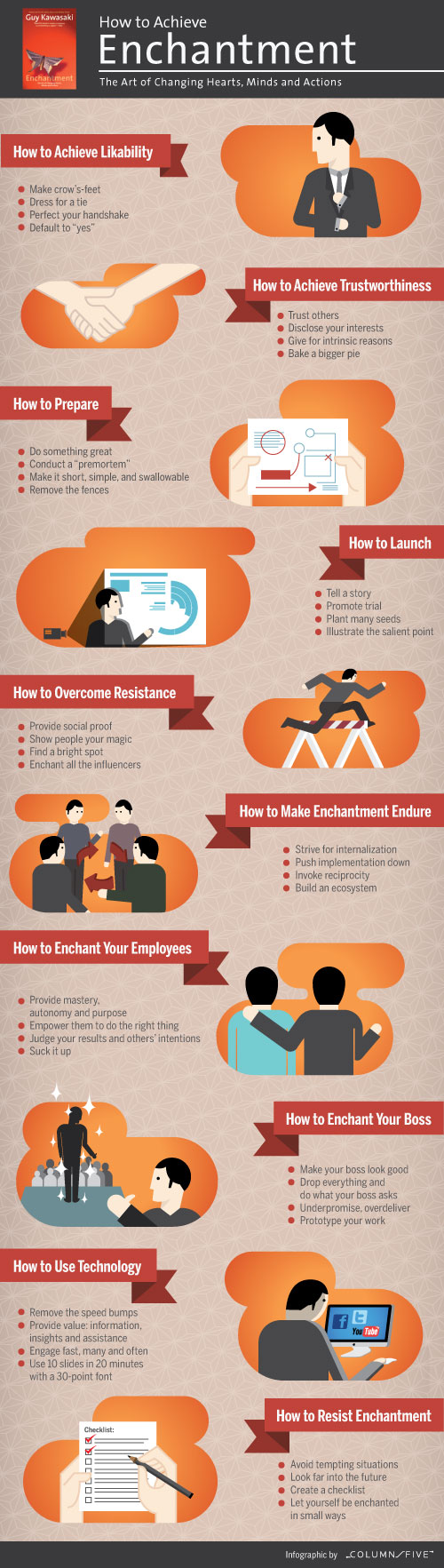
By now you must have heard that Guy Kawasaki, the master of Mac marketing has just released a new book. Enchantment covers every tool marketers, sales and even customer services people have available to them to individually and collectively enchant customers. I've written my impressions of the book, and even have a Q&A direct from the mouth (well really keyboard) of the master himself, so read on!

(On a mobile device? Click to read the mobile version.)

The big question the book addresses is "why enchant customers?". The answer, obvious to the social media generation maybe is because they advocate your products and your brand, buy more and persuade others to buy more. Enchanted customers, as Kawasaki explains with multiple examples, are a powerful force, and are way more valuable to a brand's success than the "rich, famous, and traditional influential people", the media superpowers such as himself. After all, if I can be a blogger, anybody can be a blogger, and many (most) of you are going to be a hell of a lot more influential than me. When you add all those voices together, if you can get them to talk about you, many more people are going to hear, believe what they are hearing, and will subsequently buy what they are hearing about. In Kawasaki's words "Nobodies are the new somebodies in a world of wide-open communications".

The book has been described by several reviewers as the "How to Win Friends and Influence People" for the 21st century, and even before I read the other reviews (or even the back of the beautiful book cover) I was coming to the same conclusion. There is a lot written about how you, as an individual can affect people's perceptions of you personally, and therefore the brand you represent. I wasn't reading this as enchantment (initially), just how to be a better salesman and not piss people off. As I read on though, it starts to fall into place. If you are an insincere or bad person, you are going to struggle with enchanting customers and might as well stick with conning them into buying your junk using your current devious tactics. Kawasaki reinforces the importance of being good and not confusing successfully 'selling' with 'enchanting' several times as the chapters progress. He even has a fun online test to see how enchanting you are.

An interesting theme that I found challenging in the book was around building an ecosystem around your product. I understand this is hard, and a great point that Kawasaki makes is that for an ecosystem to work, you have to create something that is worthy of that ecosystem. You need a great cause, and if you have it the ecosystem will probably grow itself. The challenge for me out of this, and many small and mid-sized businesses is providing one thing that can be identified as good enough to warrant and ecosystem, and identifying enough like minded people who can seed it. The ecosystem starts to be a realistic concept when you already have some success. I was going slow when I read this, as I kept trying to understand how a startup with five paying customers can develop and ecosystem. The book is targeted at all phases of a lifecycle of a company, and this part just happens to be down the path from where many of us are now.

So, the really good bit of this post is the stuff that you won't read in the book. A really quick Q&A. Questions are from yours truly. Answers are from the master of enchantment, Guy Kawasaki.

PA. Enchantment sounds like a wonderful goal for big brands (and there are many big names [in the book] to back it up). But what about the small businesses growing from the ground up? What is the most important thing a small business owner can learn from the book?

GK. Enchantment isn't a big, expensive, "hire a consultant to get it done" activity. Not at all. In fact, those qualities are the enemy of enchantment. The bottom line is that a small business should employ people who are likable and trustworthy, and it should sell a great product or service. Money isn't the gating item. The hard part is realizing that there is a better way to do business, and the flexibility to give it a try.

PA. The enchanting experiences require us to think differently and interact with customers differently. Is this just a change in the way we educate employees, or do we need to fundamentally change the nuts and bolts processes that businesses run to allow this to happen?

GK. There is a causative relationship: if you educate employees and empower them to enchant customers then, quite naturally, they will change the nuts and bolts processes of the business. Management, however, has to believe in enchanting customers. My recommendation is that instead of announcing a great enchantment campaign ("Oh God, the boss read another book..."), management should start with small things. Stuff like answering email faster or returning all customer phone calls. Take it a step at a time and build upon success.

PA. Working with customers in an enchanting way sounds like it is extremely time consuming and probably quite costly. Are there any short cuts a small business can take?

GK. Quite the contrary, enchantment is not time consuming and costly. How much more does it cost to smile, dress appropriately, and give a good handshake? And to act in honest and trustworthy ways. "Shortcuts" is a loaded word. I don't recommend shortcuts that amount to putting lipstick on a pig. But the foundation of enchantment is not hard or costly. It's just different. 


As you can see from just the answers here, there is a lot for small and mid-sized businesses in Enchantment. And it comes down to personal commitment and presentation, as much as complex organizational changes and expensive marketing campaigns. We think the same it seems: simple changes to the way a business works can have profound effects.


Enchantment Infographic


A post from the Improving It blog
Let us help you improve your business today. Visit www.consected.com

Friday, March 04, 2011

Do mid-sized businesses have money to burn?

Windows mobileImage via WikipediaIts interesting that as soon as a company grows large enough to fill more than a shared services office space, they consider themselves big enough to throw money around like crazy. I offered my thoughts to reporter writing a story about how small and mid-sized businesses could save money in the IT department, and realized that many small businesses are way ahead of their bigger cousins in terms of working more cost effectively -- without losing anything in the way they work.


Since I didn't hear anything from my pitch to the reporter, I'm going to share this information with you. You'll look and say, "of course - that's ridiculously obvious", but really how many mid-sized businesses have taken the plunge into saving money rather than being trapped in overpriced 20th century technology? Bear in mind also that I have 15 years experience around software, so if you know how to manipulate Dell for a better offer, let us know! (I go to NewEgg for my hardware requirements - they offer small name PCs cheaper that work just as well as the big names).


  1. Productivity Suite: Use Google Apps as a replacement for Microsoft Office. It is significantly cheaper, especially considering how small a piece of the functionality of Office most people use.
  2. Dump Windows: Now that you have a friendly Office productivity apps in place, start using Linux on your new desktop and laptop PCs, when it comes time to replace them. Nobody is going to complain, since they are doing most of their work in a browser, and Ubuntu (my OS of choice) is as clean and simple to use as any Windows 7 machine for all the remaining desktop tasks a user may have. And with that, you save on buying licenses for resource and wallet hungry virus scanners.
  3. Save it to the Cloud: Install and maintain complex and expensive network attached storage? Why bother, when cloud-based storage is cheap, flexible and saves you not only hardware, but the hassle of backups too.
  4. Need Windows for Quickbooks? Some business applications just haven't been made workable in the cloud - Intuit's offering is an example where some users will still need Windows to install some real software. So consider using virtual machines with Windows installed to run them. Why? Because the next time you have to replace the hardware, you don't need to buy yet another license for an OS you already own.
  5. Work Better! All of this has been about saving costs for IT. How about giving back to the business a little? After all, its the reason IT exists. Encourage the use of process, content and collaboration tools that will help people work better, share information better and save emailing every document they work on backwards and forward a hundred times.
Let me know your tips that we can all use to work cheaper and better.  

A post from the Improving It blog
Let us help you improve your business today. Visit www.consected.com

Wednesday, February 16, 2011

CRM made meaningful AND easy?

Small business does not need enterprise software (because it sucks) is a post I wrote just a couple of weeks ago. And CRM is one of those Big Enterprise systems that just screams "spend hundreds of thousands in consulting to implement me!". Even Salesforce doesn't make it particularly easy for small businesses that just want to manage their clients, prospects and contacts. Getting started is just too hard. Well, it seems that things might be changing. Just a few minutes ago, TechCrunch put out the story that Constant Contact Buys Social CRM Startup Bantam Live for $15 Million in Cash. For any of you who have been reading about my exploits getting my first email newsletter out to my contacts using Constant Contact, you'll know that I love what they do (and you may also remember that my wife works for them - I have not been rewarded for writing this). So I'm interested in how this new addition of Bantam Live to the Constant Contact suite will help small businesses to really know who they know.

I'm sure that Constant Contact are downplaying what this acquisition means right now. Sure, when I looked at Bantam Live during some research for my own efforts with Consected, just a couple of months ago, I would say that ease of use and fast start for getting contacts into the solution from numerous sources (including your social media contacts like Twitter) was appealing. And this is going to be considerably better than the sufficient email contact upload capability Constant Contact has available currently. But my hope is that you smart guys at Constant Contact are thinking about this more broadly. What do I mean? Well, as I have your attention, here is what I, as a small business owner want...

Just remember, as a small business owner I don't want to be looking in multiple places for customer contact information. So the CRM capability needs to really live up to the C in CRM - 'Customer'. Not just another contact I can engage through your email, event and social media marketing. But a true customer who is spending money with my business, and therefore sometimes contacts me about stuff. I need to know their history, know the key contacts, even mark some of them as 'do not send marketing emails', so that I can truly manage the customer relationship. And it all needs to just be there, up and running and configured when I first login. I don't have time, or energy to work out how to get it configured or choose from lots of options - it just has to work - now. 

It is around the true management of customers that I hope the really solid features of Bantam Live live on. Easy to use social CRM will certainly help me in the engagement of my contacts, not just through email. But the collaboration and task management capabilities seem to allow the opportunity to offer more of a small business suite than mere email marketing alone. I'm bullish about this for one reason - Constant Contact has proven to hundreds of thousands of other paying customers that they can make previously complex technology accessible to users who rarely venture away from their Yahoo home page. If they can do this with the Bantam Live CRM + collaboration capabilities, then I think they are on to a winner and will be loved by more and more small businesses, for more than email newsletters.

A post from the Improving It blog
Let us help you improve your business today. Visit www.consected.com
Enhanced by Zemanta

Tuesday, January 11, 2011

Email marketing for small businesses - the trial continues

Krúpova hoľa, Low Tatras. Information tableImage via Wikipedia
Yesterday I chatted about my quest to try out email marketing for the first time. Not spam, but the idea of sending really engaging to contacts and customers about not only my products, but many things that may interest them and their businesses.

Here we are almost half way through the first week and I need to give a little more feedback. Constant Contact throws more ideas, information and educational materials at you than you can possibly consume. This is a good thing, since they lay it out in a way that allows you to understand what you can do with the service, so you can pick the way that you absorb information best. Want to just play? Your email marketing service is there, and a quick document walks you through how you can send a test email to see it in action. Want to read some more about the concepts? Pick from a range of relevant information. Want to see an online walk-through? 2pm ET will get you that (plus some other options I don't remember). Just need a little personal Q&A? Well, my friendly Constant Contact Consultant, Jon, can help me with that. I might need him to guide me a little when it comes to our next check in at the end of the week. He knows my aims and what my company offers, and I'm sure he'll have his notes in front of him when we chat next.

So far, I have to say that I'm impressed with the amount of information available, and the non-pushy service that I've been receiving. Remember, this is all part of my 60-day free trial. I'm not paying for all this yet. Obviously, its all part of a cunning sales-ploy, but who cares when you get this type of service?!

Check in tomorrow to see what progress I'm making. Later in the process, I might even sign up for a competitive service or two, just to see which one really works for me.

A post from the Improving It blog
Let us help you improve your business today. Visit www.consected.com

Monday, January 10, 2011

Reviewing how to keep customers and prospects engaged

What a challenge it can be for small businesses to find new customers. I know, as I have to struggle with it, just like everybody else. So after all the effort of getting people interested in your products or services, keeping them interested is essential, and equally tricky. Over the next few weeks I'm going to review a tool that claims to help: email marketing.

I recently signed up for a 60-day free trial with Constant Contact, to see if email marketing is a valuable supplement to my other efforts to keep customers interested in what Consected offers, and how we can work together in the future. Can an email newsletter every few weeks work better for me than this blog, Facebook, Twitter, etc...? I think there may be a chance, since this blog is a broadcast and despite my best efforts to generate some discussion, frankly I have no idea who reads it, when or why. An email, with equally valuable content, but aimed at my customers and contacts seems surprisingly more personal.

So I will confess at this point that my wife works for Constant Contact. That's why I picked them over services. I'm a technology guy at heart, so I might have enjoyed tinkering with other options out there, and would probably have wasted loads of time. But what I need is the support that Constant Contact touts, around supporting small businesses in understanding what email marketing is, how to create effective content, and just how to use this "email is sexy again" approach to keeping in contact with customers.

For small businesses out there who are interested in my experiences, which I promise to keep fair and balanced, please sign up for this blog's RSS feed or the email, and I look forward to hearing your comments and experiences too.


A post from the Improving It blog
Let us help you improve your business today. Visit www.consected.com

Thursday, December 16, 2010

AP: I promise I'll do better next year

Seal of the United States Internal Revenue Ser...Image via Wikipedia
Many people start to wind down a little at this time of year. Calls to customers start to tail off, marketing spend for business-to-business companies slows down, and everybody starts to save their energy for buying a wrapping stuff for the kids. For the poor souls in finance and accounting, this is just the calm before the storm. Financial years come to an end with a flurry of activity, and worse yet, tax season in the US starts to cause pangs of remorse. "Why did I not keep my paperwork more organized through the year?". "What are all these travel expense receipts?". "Can I hide on a small Caribbean island?".

Well, 2010 is almost done. Feel free to spend much of the end of December and all of January running around, finding what you need for your annual reports and IRS filings. But ask yourself, "do I want to be doing this again in twelve months time?". Especially as the new health care reform bill has an impact on the tax reporting of transactions (in the same way that the housing assistance support bill did several years ago), making the accounts payable team miserable. Yes, filing 1099 forms for every vendor that you spend more than $600 with (not just the unincorporated ones)  in the course of the year sounds like running a report or two, then filling in the paperwork - not fun, but not world ending. But wouldn't it be better if you could kill two birds with one stone, fixing your messed up paper and Excel accounts payable and travel expenses processes, and ensure you can meet the 1099 reporting needs more easily?

It seems to be true that despite the hype of the burden on small business, a big chunk of the responsibility for patching up the leaky tax collection problem goes back to big business. The merchant banks, credit card companies, whichever organization handles an electronic transaction, becomes responsible for reporting these transactions. The tax code already demands this, and the requirement appears to have been extended. So, I've been complaining this week that electronic transactions are too costly for small business. Maybe that cost starts to be put into context when I consider the reporting costs in the future if I write a lot of large checks.

Its time to get ahead and start streamlining those accounts payable processes. Its really not going to be that hard, compared with the year end chaos that ensues anyway. And it could make 2011 a more restful and peaceful year, for accounts payable at least.

Remember: I know nothing about tax law or any other regulations affecting your business. So check with a professional before doing, or not doing anything.

A post from the Improving It blog
Let us help you improve your business today. Visit www.consected.com

Tuesday, December 14, 2010

Logo of PayPal.Image via Wikipedia
Yesterday I discussed why electronic payments are great for customers and banks, but terrible for small businesses dealing in high value, low volume transactions. This morning, Finextra relays the press release announcing the partnership of S1 and PayPal. S1 provides integration with online banking, so that person-to-person payments can be made directly from an individual's bank account. The actual payment is made through the PayPal infrastructure, giving the security and support that is needed for this to actually fly.

This news is interesting, since it is giving smaller institutions such as credit unions the opportunity to offer competitively priced money transfer capabilities. It starts to put in place a real competitor to the legacy fund automated clearing house (ACH) and wire transfer systems used by the banks for Electronic Funds Transfer. EFT is perceived as being highly complex and may be considered one reason why electronic payments are going to be such an expensive proposition for small businesses. If you make a payment to a small business electronically through an online banking site such as Bank of America, its likely that the bank prints and mails a check. The small business owner has the inconvenience of the paper check still. This is not an end to end electronic solution, it just suits the customer, and the bank gets to hold your money for longer.

If PayPal and S1, or similar propositions start to really compete in the marketplace, I hope this could put pressure on the big banks to start providing better and cheaper check-free approaches for business to business payments, completely integrated with real small business online banking. This is what small businesses want, direct integration, not another service that they have to transfer funds to so they can pay a third-party. The rather hefty charges, and complexity of funds transfers to the PayPal account before making the payment need to be reduced, and competition is the only way it will happen.  

A post from the Improving It blog
Let us help you improve your business today. Visit www.consected.com