Showing posts with label iPhone. Show all posts

Monday, January 23, 2012

The end of RIM is nigh

RIM BlackBerry 7230Image via Wikipedia
I remember using a Blackberry for the the first time. My boss at the time was driving to meet a client, and I was riding shotgun. Of course, he had no idea where he was going, so he handed me the blue device and said "look in my email, you'll find their phone number". Without fear, I found the little thumbwheel thing did just what I expected. A big block moved up and down and pointed to just what I needed. The device was more intuitive than I could have imagined. Even when it came to opening a browser to find the elusive phone number, then just clicking the link to call it. I needed no instruction. It just worked. So, dear Blackberry makers, Research in Motion (RIM), what happened?

I'll admit that I remember that first Blackberry use more vividly than other tech experiences. So I understand why people (especially salesmen, bored in airports) got hooked. The 'crackberry' was addictive. People needed them. So what changed? It certainly wasn't the Windows Mobile devices, which looked similar, but had the intuitiveness of a brick.

Well, the Appboy blog claims that you can blame the late, great Steve Jobs, not for changing the mobile market (at least not in this context), but for being the presenter and imperfect idol that he was. He just set the bar too high for RIM executives. His flair and presentation, his innovation, just made it impossible for a little accidental success like RIM to survive. Certainly an interesting take on it, and a scathing judgement of the new CEO.

Then of course, there is the likelihood that there were Blackberry users who wanted a big screen device (those were the days when mobile phones were getting smaller, not bigger) that felt solid and real. They weren't Blackberry fans though, and quite easily were taken by the bigger screen iPhone. Close to useless for business people in its initial form, with poor email support, virtually unusable calendar and a single mobile carrier (AT&T) unable to manage the load. So the few accidental Blackberry users who didn't really care about corporate email moved to iPhone, the masses moved to iPhone and the mobile market changed beyond recognition.

But, Blackberry should still have had a grip on the business market. It had infrastructure to support them, and an apparently intimate knowledge of how their users could make subtle shifts of their thumbs to control their electronic world. No repetitive strain inducing swiping a whole hand to scroll through your email. Typing in a moving car on potholed Boston roads was possible with a real raised keyboard (as long as you weren't driving). But still RIM lost the plot.

A touch screen Blackberry was a nice idea, though you couldn't exactly type in a car any easier than an Android. The Playbook was just stupid branding in my opinion, and apparently it didn't have a native email client, so it wasn't really a Blackberry, just a toy for the kids of Blackberry owners. It touted that it had support for Flash, just as Adobe announced that it was going to scale back development of Flash on mobile devices. Bad luck, or bad planning?

If RIM is to survive, seven minute monologues by the new CEO is not going to save them. Neither is another Playbook. As Appboy said, innovate, innovate and innovate some more. Hell, make a tablet called a Workbook with real email support. That's your market, so stop trying to expand out of the one you've got when you are barely keeping a grip on it.

I have to say, good luck to RIM. There will be disaster in corporate IT if you go away. Many people rely on getting their email through your servers. If the company goes, the infrastructure goes, and that possibly makes the devices instantly obsolete. Don't panic!


A post from the Improving It blog
Let us help you improve your business today. Visit www.consected.com
Enhanced by Zemanta

Monday, November 14, 2011

QR Code Blunders #1: Beck's Vier Ireland

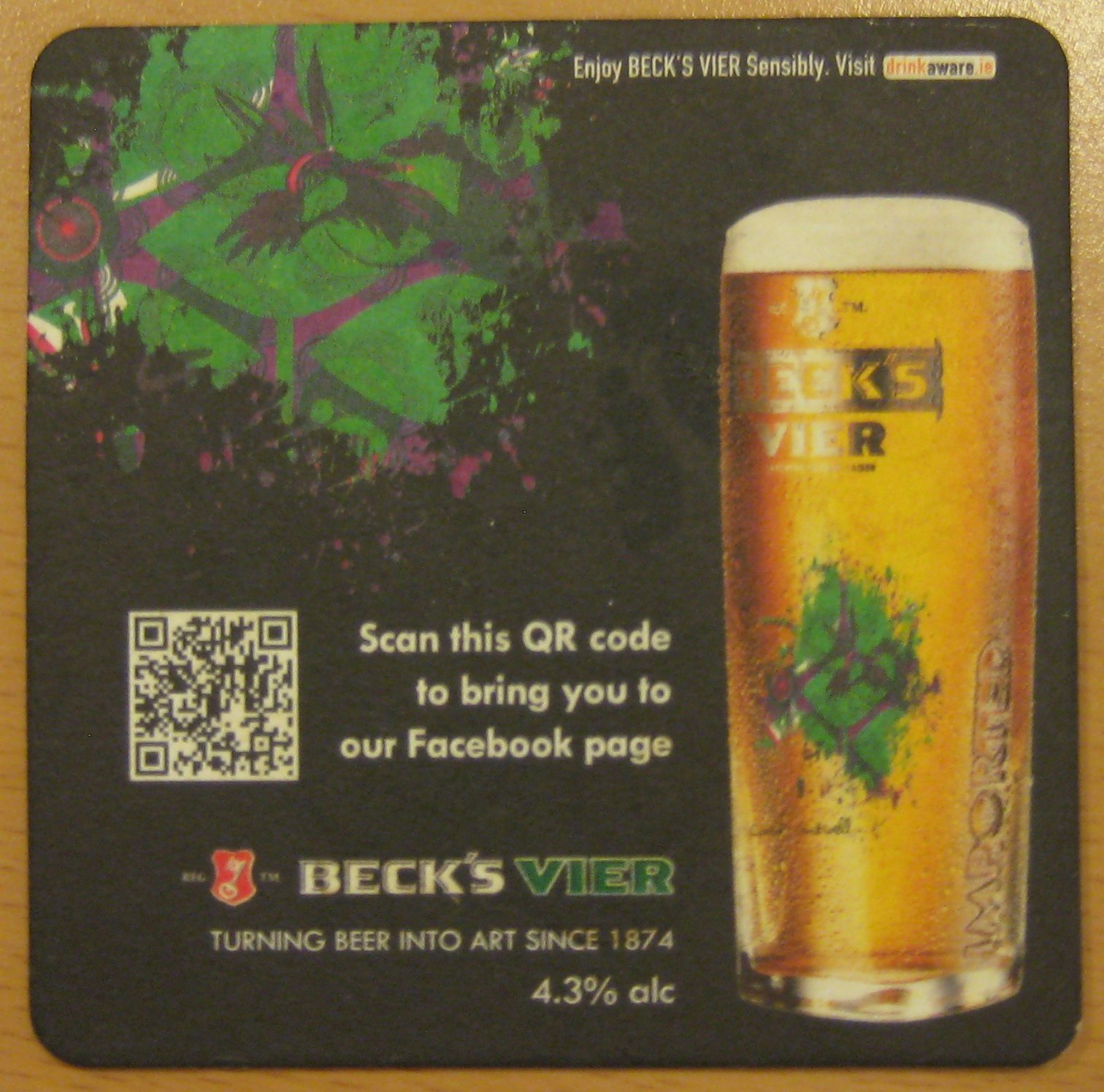
I've been meaning to start this series of blogs for ages, and tonight I realized that I had too big a blunder to miss. This is a QR Code blunder that is just too big to pass up. I'm currently in Dublin, Ireland, a land where competition for beer consumers could be considered to be large. Very large. So seeing a QR Code on the beer mat pictured here, I had to go with it.

The QR Code on the beer mat could be considered to be a smart marketing ploy (it is one I have suggested in the past and actually have a small, regional client in the UK doing). Imagine this following scenario. Think of grown men, in pubs in Dublin during the day, a bit bored while their friends go off to get another pint from the bar. Ooh, shiny object (QR Code), let's see what it does.

Well, in the case of the Becks example, not a helluva lot. Or if you have an older iPhone, even in great lighting (not renowned in pubs, anywhere), nothing at all. Beyond the fact that the QR Code is too small to scan and doesn't use a shortened URL, so it is more pixelated than it needs to be, there are a bunch of other failures:

  1. the URL points straight to the Facebook page they want you to visit - there is no real way to track this action and see how many people scanned that QR Code, so who knows whether the beer mat QR Code campaign is working? Just the webmaster at Facebook and I don't think he's going to tell you that for free
  2. the URL points straight to the Facebook page they want you to visit - "so you want me to login to the really slow mobile facebook page that my QR Code scanner sends me to so I can see the page? Oh look, here comes my pint. This thing is a joke."
  3. the URL points straight to the Facebook page they want you to visit - I forgot, this is Dublin, and the Guinness has to settle on the bar twice as long. I had time to login to Facebook. First thing I see is some irrelevant post about architects having more creativity than artists. Or something unrelated to beer (despite the really small tag line I missed at the bottom of the beer mat about turning beer into art). "Childish male drinking humour almost kicked into my brain sitting waiting for my pint - art, rhymes with...? Ooh, pretty girl just walked past. Where am I?". No click on the Like link should be expected.
So my pint turns up, and Beck's still only has 2184 Facebook friends, and everybody thinks that QR Codes are a stupid idea. Not really,  you just have to do them right and target your audience better.

Cheers to them for giving me a great example to kick off this series of QR Code blunders. And feel free to visit the Facebook page for the unreadable QR Code at http://www.facebook.com/becksvierireland (I had to take a photo with a good quality digital camera, then photo shop the image to get it to scan.) 

I hope that Bulmers, the owners of the distribution rights to Beck's Vier, and eightytwenty/4D who announced with such pride that they are handling the digital activity for the Bulmers brands realize the error(s) of their ways. And its easy for me to criticize here and now without offering solutions to the problem, but let me suggest that QR Codes work if you actually try scanning them with a real phone, life-sized, before going to print. And you don't rely on Facebook for your MAS (minimum attention span) marketing to mildly intoxicated blokes.


A post from the Improving It blog
Let us help you improve your business today. Visit www.consected.com

Thursday, November 03, 2011

Go Mobile, Global

Google is finally shouting about mobile websites. They have released GoMo and are putting on a mobile event in Alabama to start pushing businesses to convert their regular websites to a smartphone-friendly format. At Consected, we feel we need to crash the party, although we're not going to Alabama. We're not even going on the road. Read on to find out about our global party-crashing plans...

Google probably feels it can focus on mobile websites having reached a milestone with the Android platform, overtaking Apple and the iPhone as the operating system the majority of smartphones are running. They have 200,000 apps on the Android marketplace, although a large proportion of these are meaningless copies of poorly performing websites, with little or no advantage to Google in promoting their advertising. So Google has (rightly in my opinion) decided that real, mobile-friendly websites need a little helping hand. and GoMo is the way they are shouting about it - along with some expensive sponsored listings from vendors who they claim can get businesses going fast. But before you go, let's revisit why you want a mobile website and not just an app.

A mobile website helps every potential customer who wants to use a service, not just the limited number who have a phone that works with the app. Apps are great for software developers who have a contract from big corporates to build them, first on iPhone, then on Android, then maybe a Blackberry version. Apps are great for consumers playing games and using real productivity applications (think of Excel on your phone). They are completely unnecessary for the majority of mobile marketing requirements (I don't need an app to search for special offers from my favorite retailer, TalFart). And, as people are starting to find out, many apps don't work well on tablets like the iPad or Galaxy Tab, well unless you like a pokey little mobile phone sized app in the middle of your large screen, or want to pay the developer even more money.
Holsworthy Ales mobile site
A very recent new client

Having a mobile website is essential if you have a business with customers on the go. So feel free to try out some of the services that are being touted through the Google website. Please accept a little advice though -- spend some time really looking at the result. A nice menu, all the text from your website pasted blindly on the page, much of it irrelevant to a customer trying to find you on her smartphone. Everything else stacked at the bottom, as the robot creating your site didn't know what to do with it. And really very little control over the end result (pink or blue is about the choice). This is why Consected wants to crash the mobile party. A mobile website is not just a vertical version of your current website. It needs some TLC and a real person.

Here is where we crash the Google GoMo party. We will create a custom mobile website, by hand (think of an artisan mobile website) for any customer who prepays for a 12 month mobile website hosting service with us. You'll get:

  • a real, working, zero effort mobile website
  • a home page following the style of your current website
  • a contact page with "tap to call", "tap to map", "tap to SMS", and links to your Facebook, Twitter, YouTube and LinkedIn pages
  • up to three pages describing your services or products (we'll even edit the text to make it useful and concise)
  • your logo in the header
  • ad-free and our logo does not appear anywhere on the page
  • QR codes for every page
  • your own domain name linked to the site
  • free access for you to login and change any part of the website you desire 
You don't have to be in Alabama to claim it. You don't even have to be in the US. The time for us to build the website by hand exceeds the value of the hosting service, making the mobile site effectively free. Free is a pretty good deal for a mobile website that looks professional, useful and something you can use to promote your business.

To join us in crashing the Google GoMo party, and claim your own mobile website, built by hand, just fill in this quick form: http://cnsd.co/5n5


A post from the Improving It blog
Let us help you improve your business today. Visit www.consected.com

Wednesday, October 05, 2011

Apple does little but keeps app developers busy

Apple collected a lot of tech reporters together for an event to make a big announcement. Everybody held their breath, guessing at what the next big revolutionary change would be in the mobile space. What huge leap would we see in smartphone technology? According to Mobile Marketer's Chantal Tode, this amounted to not a lot except that the Apple iOS update poses challenges to existing apps in App Store. Yes, there is an iPhone 4GS, the next version of the ever popular smartphone, but its not ground-breaking. Instead, it was time for the operating system software, the "face of the phone" to move forward.

And this represents a dilemma for many people. Unless you are desperate, you're not going to buy a 4GS, knowing that the chance is greater than ever of an iPhone 5 with a great new screen and cool new stuff being just around the corner. If you are the owner of the iPhone 3 (like me), with a device that is running slower and crashing more than ever, will you even have access to the new iOS upgrade to hopefully fix some of your issues introduced by Apple's previous update? That could give your phone a few months more life (hopefully not screw it up even more), perhaps putting you in the running for an iPhone 5 (not me, I'm going to try Android next time).

And for app developers, the guys and girls building all the apps you find in the App Store, the 200 new features that could help some apps work better, break others, and finally completely replace others still, make for a busy time. The iOS software is tired, it need some TLC to make it more desirable, and hopefully add some of the missing essential business features (rich text emails for example). It needs to allow me to get notified of things that are going on with less pop ups. But any major change to an operating system represents a challenge for developers. In testing, in new development to benefit from new features, in quick fixes and late nights.

Of course, if you don't want to have to worry if your business's mobile app will work on iPhone 4GS, 5, Android, Windows Mobile, etc, etc, then it is worth considering developing using open standards like HTML5. Otherwise known as good old "web development". With some work, a mobile optimized website can avoid the constant arms race against for each vendor you want to support, giving you a consistent, easy to use and highly functional mobile website or app.

Thanks Apple, I won't hold my breath until your next big smartphone breakthrough. Mobile web optimized apps are already on their way, and companies like Consected are making them more about configuration and self-contained solutions, and less about development.

A post from the Improving It blog
Let us help you improve your business today. Visit www.consected.com
Wednesday, May 04, 2011

Future payment transactions - not as dumb as paper

Pay by phone, the smart way to pay
(Image from Mobile Marketer)
Mobile payments technology is a hot space at the moment. The ultimate goal is to make small retail payments easy, fast and cheap for businesses and consumers. This means that the solutions have to get away from paper, coins and magnetic swipe cards with huge costs attached to every transaction. Add consumer interest in everything about mobile device apps on iPhone and Android, with location services and the ability for the devices to communicate for themselves (something no credit card can do), and there is a huge opportunity for the company that owns your data to direct your future spending with loyalty programs and offers. It is with this in mind that PayPal announced its acquisition of Fig Card - this story in Mobile Marketer adds some nice commentary.

Now that's not to say there aren't challenges with mobile payments. If it was all as easy as just tapping your phone on a black box to pay a retailer, we'd probably not be carrying cash already. The challenges amount to these, and Fig thinks they know the answers:

  • Making the hardware retailers need simple, cheap and secure
  • Getting enough retailers interested in doing something different
  • Educating consumers on a new approach to payment
  • Ensuring that consumers don't need new hardware, just a new app
  • Building a secure infrastructure that can capture payments for a retailer without them ever storing consumer's details
  • Being able to scale the infrastructure to support a nationwide, then international payment infrastructure
  • Putting together value add features such as loyalty programs that offer consumers more and make the service pay for itself
PayPal seems to be in a good position to offer much of this know-how and the backing to make it happen. Fig Card gives them the opportunity to go out and chase the incumbent credit cards with a viable alternative, addressing most, if not all of the challenges above. And they haven't forgotten the appeal to retailers, consumers, and their own bottom-line in the power of information.

If future payment "transactions can be as smart as a computer and not as dumb as paper,” (to quote Mr. Chu, Senior Director of PayPal Mobile), then PayPal could be hot on the heels of more than just the payment card industry. Move over Groupon - if you don't own the payments, you know nothing about potential customers. They may just stop coming to you, when more appropriate offers come to them at no cost.

A post from the Improving It blog
Let us help you improve your business today. Visit www.consected.com

Tuesday, April 05, 2011

Is the process app store the future your business processes?

Image representing iPhone as depicted in Crunc...Image via CrunchBase"Is the process app store the future of BPM?" was today's discussion on the ebizQ business process management forum. Should we buy business processes (such as travel expense processing) in an online app store, the same as we buy Angry Birds for our iPhone? As much as we would all like to believe that process applications can be delivered this way, getting a replacement business process implemented is tough. You have to:

  • find a process application that fits your needs
  • get it customized, configured and generally implemented
  • manage the change of people's attitudes and activities internally to get it to work. 
Since business processes are so much part of the DNA of a business, implementing new ones makes them extremely hard to deliver as apps. Even a simple travel expenses process or a holiday/vacation request process is done in a million different ways by a million and one businesses. Why would they want to change the way they work to fit some cheap application they bought online?

My own experience, putting pre-built process apps out on Google Marketplace is that even if small and mid-sized businesses (SMBs) come to take a look, they can rarely spend the time to really dig in and understand what the app can do. A cursory single look, a "this sounds hard" internal discussion is about the best you can expect. No matter how much person-to-person hand holding you offer (and trust me, I've offered), the typical app buyer in a small business just doesn't have the time, resources or motivation to get a real process change implemented. As Ian Gotts commented on the forum:

For an SME this is too hard. Instead, they continue to run on "staff heroics"

Now I'm not saying that the apps we deliver at Consected are always perfectly simple to use! The ultimate flexibility that is rightly demanded by the buyer whatever size company, balanced against the "so simple a caveman could do it" need, makes these applications more expensive to develop than the $4.95 per user per month cap that seems to be the limit anybody will consider (often less). 

The next issue really comes from a complete lack of change management being possible when you sell through an app model. Being able to work with a customer remotely who doesn't have time to really speak to you, or any real wish to speak to you, makes any sensible change to the current business processes really hard. The best business process implementations come with a change to the way work is done, not just moving it "to the cloud". Apps give the impression that we can just install and go.

Apps need to be really well packaged if they are delivering business application functionality through a software as a service (SaaS) model. Which means that the value of a flexible process environment is lost on the end user, because too many options just get in the way. But without the flexibility they can do their job the way they need to. Somebody will work out the magic to this, though its definitely harder than it appears! 

Successful app vendors have to play a numbers game and sell large volumes to make any real money. And business processes seem to rarely fit the one size fits all requirement to make this happen. So please feel free to take a look at the Consected Instant Apps. They are free or cheap (by enterprise software standards). And although they require a little time, thought, and some communication with us to get them to really fit your needs, they can make a huge difference to your business.


A post from the Improving It blog
Let us help you improve your business today. Visit www.consected.com

Tuesday, March 29, 2011

Making a big deal out of mobile

Publishing a website suitable for mobile phones used to be a real challenge. There were many factors that played into this, pre-iPhone, and it wasn't just the size and usability of the screen:

  • Bandwidth was limited (oh yes, you think AT&T "4G-is-coming-because-the-rest-of-our-service-is-sooo-slow" is bad, try booking a flight over a standard GSM connection)
  • Usability was clunky at best, Windows Mobile at worst
  • The software development tools were limited, web protocols were obscure (for standard web developers), including WAP and others, all trying to seek standardization and best use of bandwidth, and achieving limited adoption
  • The mobile devices just weren't ready for the general public's use of the Internet (I would struggle with one, my wife would throw it out the window)

Things have progressed in leaps and bounds. The devices are amazing to use. Even the cheapest smartphone 'handset' offers a pretty decent 300x400 pixel screen, completely adequate for browsing simple, standard HTML sites. We have mobile web browsers, with real browser technology squashed down from the desktop. From a distance, things look like websites.

Some devices like the iPhone 4 even boast 900x700 size screens. But that just squashes everything into the same physical size. Side by side with an iPhone 3, the new one looks crisper, sharper, brighter. But it doesn't really do much for my overall web browsing experience. iPad and other tablets aside, the phones have reached a plateau on what they seem to be sensibly delivering from web browsing capability. 

So I'm regularly asked questions like "but an iPhone can browse regular websites, right? So why do you need special mobile sites?". The answer is clear when you actually try. This blog appears okay on an iPhone, if you don't mind zooming and dragging the window around to read it. But anything with multiple columns, Flash, crazy drop down menus -- well, they're usually usable but tiring, and often just look ugly.

So you want to impress customers with your new fancy website? Make sure that those customers who are on the move can get your information fast, clearly and easily on a mobile website built for mobiles. Because you can guarantee that after waiting 30 seconds for a web page that is mostly flash and wide columns of text, they will just hit Google and search for your competitors. 


A post from the Improving It blog
Let us help you improve your business today. Visit www.consected.com

Friday, January 14, 2011

Barcodes - bigger than beans

Barcodes are on virtually every product we own, from cans of beans and iPhone boxes to airport boarding passes. Even look in hidden parts of your car like door sills and you'll even find them there. They are everywhere, so we ignore them. But they are everywhere for a reason. For a business to organize information, the humble barcode is invaluable. 

With the advent of the 2-D barcodes such as QR code and Data Matrix, we have seen people start to embed carefully encoded URLs, which will allow your smart phone barcode app to take you to an individual web page. Incredible for marketing. Equally incredible for business information.

The examples in the image show exactly what I mean. Starting at the bottom image, the lowest common denominator is a simple URL. Point your smart phone app at that, and it will take you to a very special web page. Marketing at its best! 

In the middle we have a UID sticker, a printable label that describes all the relevant details of an imaginary aircraft component, allowing the supply chain for aircraft parts to be managed more carefully. Scan this and you'll instantly know what this part claims to be, and where it came from. Then at the top, let's manage people in the same way. The secure visitor's pass goes one better than the old sign-in book on reception desks in traditional offices. Have a person greeting visitors enter their information, capture a photo with a webcam and click GO to print the visitor's badge. Better yet, the next time the person visits the information is already in the system (unless they want a new photo with the much improved hairstyle!)

There are many ways, outside of just scanning stuff in the supermarket that barcodes allow businesses to run more efficiently and control their products and information (check your electricity bill, I bet it has a barcode on it). We have many ideas from experience (both ours and the 120 customers already using Consected Barcode Templates). Many of which of these ideas we have already, or are planning to put into ready to use templates. If you have something you need, just let us know.

A post from the Improving It blog
Let us help you improve your business today. Visit www.consected.com