Tuesday, August 22, 2006

Changing address is as simple as shopping online

Things change. Where I choose to live is one of those things that is undergoing a gradual transition. My 'identities' are changing with it.

The view from my window in Boston, which is the banner picture on this blog, is associated with the glow of the floodlights from Fenway Park and the bustle of post-game Red Sox fans and Berkley music school kids.



This view is gradually being replaced through the physical manhandling of boxes of stuff to a new home as I move in with 'the missus' a.k.a 'my girlfriend'. The new view is more relaxing, though the transition comes with a little stress, beyond the pure manual labor.


Its been a few years since I made a move. Fortunately things have got easier as more and more organizations embrace online services. Within about an hour I had made a change to most of the major mailing addresses I have on file with organizations scattered around the US.

For many organizations this type of address change should be relatively simple, since I already have an online account with them, which I use to identify myself. My residential address is just an attribute of my profile, rather than an attribute used to identify me. Financial institutions especially, but almost any organization, just need to email me a confirmation message about the address update to ensure that fraudulent changes to my information can not occur without my knowledge. Hopefully this will be more successful than the experience of Jim Davies from Gartner.

The problems come once I start trying to change my address with organizations that identify me offline or tie services to my home. Offline identity seems to regularly have residential address as an essential component of the identity. Utilities like electricity identify me this way since they only supply their services to that address. I need to recite my address to change my address - it seems like there is too much dependency on this one item of information!

Worse still is the US Postal Service (USPS) - they have little option but to identify me through my mailing address. Cleverly, they enabled my to submit a change of address online even though I have never had contact with them before.

The USPS approach is to validate a customer lives at the address they are attempting to change in a comparable way to PayPal setting up a new customer account. USPS as I say has no idea when I hit their website who on earth I am. So they choose to validate my address through the use of a trusted third party - my credit card company.

When I request an address change, USPS requests I enter my credit card details for a card with a billing address that matches either my old or new address. They make a set charge of $1 to the card, enabling them to pass my name and the address they want to compare to the credit card company for standard payment authorization. If the payment is successful USPS accepts the address change, since the credit card company has authenticated my card, name and address match. For me the customer the $1 payment is well worth the time saved going to the post office to register my change of address. For USPS, they get instant validation that this otherwise unknown customer is authorized to make the address change.

Financial institutions, due to fraud and anti-money laundering customer identification programs have some of the best mechanisms for ensuring most up to date and accurate records of their customers' profiles and personal information. It is natural that secondary organizations, both financial and otherwise would choose to accept customers' relationships with their primary financial institutions as proof of identity.

Online payments have produced a novel way for identity validation to be performed, at little cost to the the secondary organization or customer. And even more importantly, the mechanism uses standard payment methods to complete, not requiring additional integration effort or agreements with the third parties to run the transactions. Maybe unwittingly, credit card companies and banks have made themselves a primary validator of my identity, through both their own needs to ensure they know me and the mandates of the regulators such as FDIC. The major cost of initially identifying me is borne by the bank and credit card company to enable them to maintain a relationship with me. Maybe each of these small transactions made by secondary organizations wishing to identify me helps to offset this cost over time.

Technorati tags:

Monday, August 21, 2006

Top-down BPMSs suitable for Straight-Through Processing?

It seems that Bruce Silver and Jesper Joergensen have been having an interesting discussion around the marriage of BPM and SOA. Normally I would avoid any post on this subject, since I can look at the patterns of letters on the page through squinted eyes and know that its going to get too deep, too quick. These posts though have led me to a question that keeps coming back to me: should top-down business process targeted BPMSs be used for Straight-Through Processing (STP), and if so what makes one better than another?

In his post, Bruce specifically talks at a level that really makes sense, rather than the usual "we need BPEL/BPMN/WS/SOAP/I'm smarter than you by being able to use technical acronymns in seamingly meaningful ways that are completely unrelated to the real issues". He hits all of the points that I have been seeing over and over, but in a way that does not open the door to deep semantic discussion, which is fine by me. I have summarized Bruce's comparisons heavily:
  • BPM is top-down. SOA is bottom-up.
  • BPM is business-driven. SOA is IT-driven.
  • In BPM, success is measured by business metrics and KPIs at the end-to-end process level. In SOA, success is measured by architecture, logical consistency, ease of integration.
  • BPM is project-oriented. SOA is enterprise infrastructure-oriented.
  • In BPM, what is reused is the process model, i.e. the “abstract” design of a process fragment. In SOA, what is reused is the service implementation.
  • In BPM, a business process is inherently hierarchical, composed of nested and chained orchestrations. In SOA, services are inherently independent.
  • In BPM suites based on service orchestration, process activities are bound to service endpoints. In SOA (supposedly), orchestrated services are supposed to be abstract, with connection and mapping to endpoints mediated by an ESB.

These points make sense since they describe the classes of software-based solutions that are BPM and SOA, not individual vendors take on it. Given these definitions there seem to be different classes of BPMS, some highly human process biased, others more SOA biased. In my head I have not really been able to work out what it is that distinguishes one from another since all of the BPMSs I have had contact with have been human interaction based with some plug and play integration capabilities. Is it just that the more 'toolkit' type BPMSs have an SOA bias since business users can't really use them?

My belief up 'til has been that the top-down BPM types of tools are good for 'STP' where there are breakouts of the process requiring human exception processing. I think that they may also be sensibly applied to business processes that can not be implemented as pure STP as a big-bang reengineering, instead having STP as an end goal that is approached through refinement and iteration of a live business process over time.

In Part 2 of his series, Bruce says he will talk about the way current “SOA-based” BPMSs work. I'm hoping that this addresses my question: should top-down business process targeted BPMSs be used for STP, and if so what makes one better than another? If not, I'm going to have to accept that there is an obvious answer to my question that I'm just missing!

Technorati tags:

Friday, August 18, 2006

P2P financial services has a 3D Long Tail

In my post Financial products have a Long Tail I argued a little that the Long Tail model could be applied to financial services and right now is especially evident in the online brokerage accounts and tools available from the likes of E*Trade and Fidelity. I chose to focus on these types of accounts over retail banking with on a little thought or explanation. As I suggested in the post, banking is most useful to me by picking a pervasive bank with ATMs everywhere; Bank of America fits that bill. As a consumer I'm not going to head much further down from the fat-arse end of the tail to the smaller banks and credit unions because there is no real advantage to me exploring the niche options. I am not a niche customer of the banking world, so I shouldn't have used myself as the reference.

James Gardner responded in a comment that directed me to one of his posts about how the Long Tail could be applied to banking. He had identified Zopa (in the UK) and Prosper (in the US) as Long Tail contenders:

What are Prosper and Zopa doing? Democratising the production of loans: now anyone can be a bank! Selling the niche: chances are the loan terms that best suit you are going to be available where there are thousands of consumer created loan products. Zero cost distribution: the loan is matched and fulfilled automatically.

Zopa and Prosper are long tail business.


That is the key: "now anyone can be a bank", the same way as with eBay anyone can be an online retailer. That is the thinking I should have done around this!

I would also like to extend James' thought. In most of banking and credit there is a Long Tail of the population that is unbanked; for some reason they can not gain access to financial services, or at least not more than the check cashing branch on street corners.

The unbanked population does not fit the peak end of the power curve that represents customers that are likely to be appropriately profitable and of acceptable risk to many banks. James Taylor has written much about how Enterprise Decision Management can actually ensure this, enabling banks to effectively manage their customer profile during account opening. For the Wal-Mart type banks, this makes absolute sense; customer profile matches the inventory of products the bank chooses to offer. Even in an online world the banks operations are not flexible enough to offer a greater array of products (beyond an Internet only account maybe), so they target the mass of standard customers.

Looking at the new online financial services, Zopa and Prosper; they offer the ability for everyone to be a bank, offering an enormous set of credit products for a credit customer to pick from. In doing so they appeal to the different niches of customers with different needs, allowing them to gain access to credit that would otherwise be impossible.

There is another product in this new financial world, which makes this a peer-to-peer (p2p) form of trade. Looking at it from the other way round, each of these niche credit customers is like an inventory item or niche investment product for the investors. Now the guys with the cash have a Long Tail investment products with varying degrees of risk to select from, which they can select off the virtual shelf of Zopa/Prosper.

I don't believe that eBay customers can be viewed as a Long Tail of 'products' in the same way. For the new financial services, the two credit product / investment product views exist because both parties are benefiting financially from the transaction. This new wave of financial services presents a kind of 3D Long Tail of potential credit / investment product matches for both parties to benefit from. This is a powerful offering that extends beyond the 'community/social' banking brush it could be tarred with, which (if I wanted to really push my limits of credibility) could lead to a whole new form of Long Tail trade.


Technorati tags:

Wednesday, August 16, 2006

Would BI Vendors really buy into ECM?

This was such an unlikely sounding item I had to post about it. A recent post by Alan Pelz-Sharpe mentions an IT Week piece in which he is named alongside Mike Davis from Ovum.

In there Mike talks about the possibility of BI vendors like Cognos and Business Objects continuing the trend of acquiring ECM vendors. This has all been triggered by the IBM announcement around FileNet, and is probably no surprise as analysts try and out-bid each other trying to guess who will be next. Alan, like me, seems to have a different opinion about the match of BI with ECM for this to happen, and Alan's is well worth reading, based on historical context of where this has caused trouble in the past.

As I mention in a comment on Alan's post, the acquisition of an ECM vendor by a BI vendor...
Seems like an odd choice to me. I'm not sure I really understand the use cases for structured BI tools in unstructured content. And selecting acquiring companies purely based on size, rather than fit, is something that I hope we don't see as a trend.

Admittedly, real-time analytics like Aungate provide an interesting take on BI for unstructured information. BI alongside content management seems better when looking at structured metadata, especially when linked to BPM data. But that works nicely as a partnership if the analytics capabilities exceed what is available in the content management suite.

I strongly advocate getting information out of unstructured form if it needs strong BI. Strong analytics need suggests that the data should be freed from the spreadsheet constraints, while providing more control and repeatability around the data. Maybe I'm behind the times!:(

In many systems and business processes, unstructured data is often a byproduct of other poorly operating upstream processes, or the (shrinking) requirement to communicate with customers on paper. The creation of Excel spreadsheets is often the sign of immature processes in my view, although it is one of the few scenarios I could consider useful for structured BI against documents.

If Stellent, Open Text, or Vignette (please no! you won't take me alive), are swallowed by Cognos or Business Objects, I would be surprised. If they have some killer use case I haven't yet imagined, then cool, but I think its going to take some selling!


Technorati tags:

Tuesday, August 15, 2006

On being acquired by a bigger ECM vendor

The IBM acquisition of FileNet made me start thinking about how companies manage acquisitions and subsequent integration very differently.

I used to work for Tower Technology, an imaging, workflow and records management vendor that was acquired by Vignette (my current employer) back in 2004. Reminiscing, I went to the Way Back Machine to dig out the old, lurid colored Towertech.com website. Interesting headlines on the homepage about recent customer wins (back then) in the US, Europe and Australia made me think about how Tower used to consider FileNet their number one competitor. I'm not sure, maybe purely because of size, that FileNet considered Tower a great threat, but probably acknowledged the Australian company's existence.

The first positive thing Vignette did was to change the garish colors of the Tower website, replacing it with a more acceptable Vignette look. Unlike EMC with Documentum, Vignette did not retain the Tower Tech name, and within days mostly replaced the messaging to fit more of a Content Management theme, which the mother company was most comfortable with. The first home page after the acquisition was substantially different in messaging, and I remember the shock of many salesmen to find out that they no longer knew the story behind what they were selling. They were also worried, because a significant portion of leads came from Google, and it looked like Tower web properties were going away.

Much of the core talent behind Tower Technology, its Integrated Document Management (IDM) product and Enterprise Records, Document and Case Management product (then Seraph, now Records and Documents) fortunately survived. Many have done wonders to rebuild the messaging, to integrate with the Vignette organization and technology, and to take forward a stronger ECM story.

Sometimes I have to ask myself, wouldn't it have all been easier if the Vignette marketing group of the day had not messed with the brand and the messaging, allowing itself to learn over time how to really take these products to market under the Vignette banner? EMC seemed to get it right with Documentum. Will IBM get it right with FileNet?

Just to round up the thoughts out there, Sandy Kemsley did a nice round up of the comments around the Big Blue acquisition of FileNet: Comments on the IBM-FileNet acquisition - Column 2 - ebizQ

Not all were in agreement that FileNet's BPM was the focus of IBM, although I must say that the content-based BPM offered by FileNet certainly is appealing to customers wanting to capitalize on their investment in content management rapidly. Hopefully the dust will settle and we will see this as more than a land grab and door opener for the IBM sales-teams, and some real use made of the technology and most importantly the FileNet expertise.


Technorati tags:

Monday, August 14, 2006

Financial products have a Long Tail

I finally succumbed to the hype and an extended period of time waiting at Boston Logan airport. The opportunity to buy a real paper book presented itself in the form of Chris Anderson's The Long Tail. Sat in prime position on a Borders' display, it must be deserving of every penny of the $17.50 per year that few square inches of space cost the retailer in rent and overheads (my estimate from Anderson's figures!).

I was flying to Austin, Texas via Atlanta, to take a short notice trip to Vignette's HQ. By the way, one day very soon the company will complete the migration of its corporate www site to its V7 flagship product and I might actually be proud to link to it. In the meantime its just a courtesy. This introduction into my travel schedule is also an implicit excuse for a lack of posts over the next few days.

On the flights, fired by a lack of carry on luggage (I don't need the extra hassle of buying toothpaste and other necessary items every time I travel, so I'm happy not to have to fight the masses for another piece of prime real-estate, an overhead bin), I ploughed through the first 178 pages of the book. Which only leaves me about 50 for the return trip - best do some real work I suppose!

In any case, the book made me start thinking (and I apologize if this is addressed in the last 50 pages) how the Long Tail might be applied to financial products. I'm not thinking bank accounts, since I believe they probably need a bank to be relatively pervasive to work effectively right now, as I don't wan't ATM charges every time I need cash. More effective would be items like loans, insurance, mutual funds and annuities.


Financial product Long Tail

The Long Tail probably can apply quite effectively, assuming I limit the scope a little. For any of financial product where I invest my own money, I would suggest that the Long Tail applies to the multitude of products from recognized and reputable institutions that fall outside of the Top 500 'Hit' products. I don't want to include marginal or unheard of institutions into the mix since the risk of me losing my shirt is far higher than buying an unwanted birthday present from someone unknown on eBay. Although it has to be said that Zopa has a good model for investing in loans that people seem to trust, despite its relatively unknown status.

There are financial institutions that have built their brand on the ability to sell a vast array of securities, independent of popularity or ranking. Go to Fidelity, E*Trade, or another online brokerage and they will offer stock in many companies that could be considered to be in the mid-portion of the Long Tail, all as part of their standard low-cost service. And they provide many of the filtering and advice tools that Anderson suggests are necessary to help customers when facing a bewildering array of options.

This meets two of the requirements for the Long Tail according to Anderson (page 57):

  • Democratize distribution - e.g. Fidelity is just an aggegator of stock for sale
  • Connect supply and demand - e.g. E*Trade provides tools to enable customers to select stock based on many sources of information
The final force for the LT is 'democratize production'. Although I suppose anyone could run a public company, SEC regulations and Sarbanes-Oxley (SOX) seem to be making that harder and more expensive than ever. This could be considered as to ensure that production of public company stock is never really democratized, all in the best interests of the public investor (!).


The discontinuous Long Tail

Sliding down the slope to the more distant end of the LT appendage will place you into the 'penny' stocks. These don't meet the rules or the volume of trading that would have them listed on the Nasdaq, therefore making it more difficult to find out information about them, or even their current value. Given that, E*Trade for example will allow you to buy them online, although the restrictions really separate these stocks from those higher up the ranking. This is not the seamless LT that we see with iTunes, where rank does not affect the ease with which I can buy a track. With penny stock the LT is a little discontinuous, where we can no longer apply the common structure and rules of NASD to the items we want to buy. Its a bit like iTunes trying to sell vinyl albums when you get to an imaginary point in their database where the item you want exists but has not yet been digitized.


Complex products have more to gain

With complex products like annuities, where the number of combinations of securities components coupled with insurance components is enormous, the rules and potential benefits of LT could really kick in. Advanced consumers could benefit greatly from matching the endless array of products to exactly their requirements, if the information and access to products through a single online access-point was available. In this mode though there are many other issues that do not face Amazon and Google, like licensing of advisors and agents, assessing suitability for a product and so on.

The Long Tail could be enabled by the work that NAVA is doing to prepare the annuity industry for online account opening and management. Fidelity and E*Trade could for example start assembling and selling a far greater range of annuities, at a far lower cost of production. This matches the requirement for a LT to reduce the cost of production, with the brokerages standards for aggregating distribution and provide filtering to match products with people.


Summary

Financial products have probably followed a partial Long Tail model for a while, especially around the online stock brokerages we are familiar with. The costs of production may have risen, but to the customer the distribution costs and filtering / information tools have provided a far enhanced and more varied environment to trade in.

Other more complex products like annuities could greatly benefit from the Long Tail dynamics. The manufacturers of these items require a significant push, both in terms of standards, but maybe also something (or someone) else to put them into a state where they can benefit from this new model of selling 'less of more'.

[UPDATE: Apparently I messed up a couple of the links. All fixed now. Sorry!]

Technorati tags:

Friday, August 11, 2006

Citibank Hardware Tokens Defeated - but don't blame the tokens

A post today at Bankwatch » Citibank Hardware Tokens Defeated: The Beginning of the End
pointed to an AllPayNews article about the weakness of physical tokens (like the RSA SecurID). The article talks about how Citibank's online banking security was defeated by a fairly simple phishing method, despite the use of physical tokens.

As it turns out, the article was a push by a security token vendor, PhishCops. In any case, it did point out an apparent weakness of SecurID type security tokens when implemented without other anti-phishing measures.

According to the AllPayNews article, the scam worked like this:
In a textbook example of a "man-in-the-middle" attack, Citibank business customers were lured to dozens of counterfeit websites located in Russia where they were prompted to supply their token-generated passwords and other credentials. The counterfeit websites then swiftly sent the solicited credentials to the genuine Citibank website where they were used to access the accounts.
For background on tokens, see my recent posts around electronic signatures and the use of physical tokens
to strengthen the standard username/password pair for user authentication at online banking and other financial sites.


How did this work?

A valid Citibank online service would prompt the user for their standard login details, an account ID and password. Knowing which account the customer is attempting to access, the service now requests a one-time number to be entered from the user's token. SecurID and similar tokens rely on a user specific number being generated that remains valid for 30-60 seconds after being displayed on the device's LCD screen. The user enters this number into the online prompt, confirming that they are in possession of the token. The two-factor approach, an item that is memorized (password) and an item that is in-hand (token) ensures the authenticity of the customer.

The problem is that the scam used an advanced phishing approach. Not only did the scam direct customers to a website that presumably appeared exactly like a Citibank website, prompting them for all of their credentials, it immediately used these to access the real Citibank online service with the provided information. Assuming that the scam site completed this within the lifetime of the one-time password (30-60 seconds), it would be successfully authenticated, enabling the scammers to perform fraudulent transactions on the customer's account.


Tokens don't work?

Tokens with a limited lifetime passcode are still very valuable devices to ensure authentication of users. Even if both password and one-time passcode are stolen, the fraudulent user has to exercise them in a very short amount of time. Certainly this is a strong barrier preventing many keylogging and phishing attempts, but as is demonstrated here, not all.

The problem is that tokens don't close the loop. Although the banking service can confirm that the user credentials entered truly are the two-factor identification for the customer, the customer still has no way of being sure that the site they are entering this information into is real.


Need to prevent users entering credentials into fake sites

It is essential that online services provide a mechanism for very obviously confirming to users that they are using the real site. Educating users to study the URL is really insufficient. Anti-phishing toolbars are also an option, but since many users who travel may use PCs that are not their own for access to online services, this is also impractical to depend on. A good option is the SiteKey as used by Bank of America.

SiteKey is a way of demonstrating to a customer that they are looking at a valid BoA site. When attempting to login, the only information requested on the front screen is basic ID, the account number and state you live in. This is submitted to a the secure site, which retrieves a picture and a phrase. These two items were selected by the user when the online account was setup, and are only known to them. Users learn that they should only enter their password if they see this personal SiteKey. The SiteKey page shows how this works visually.


PhishCops goes a step further

The PhishCops 'virtual' token claims to be able to counter phishing sites, since even if the user's credentials are handed over, fraudulent use of them is impossible without the PhishCops token on the user's PC. PhishCops is not a physical device, and claims to be purely browser based.

The 'how' is not entirely clear to me, but it seems to be done by handling two way authentication and authorization of specific user PCs (I wasn't going to open the MS Powerpoint presentation to find out). It seems that the secure site presents a one-time key that the user enters into PhishCop, then the virtual token returns a one-time passcode to be entered into the website. This seems like a great idea, since it validates to the user that the website is real before they ever enter their credentials, and validates to the website that the token and user credentials are real.

The downside that I see is the need to pre-authenticate different computers that you want to use with the system. The process for performing this, and its complexity is not clear. I also wonder whether keylogging software, and scripting hacks could also break the system. A physical token is powerful since it is completely separated from a PC.


Summary

Physical tokens are not dead. But as the Citibank example has shown, without providing additional layers of protection to users to help them avoid phishing, a well crafted, realtime scam can defeat even this two factor authentication.

If Citibank had used a site authentication approach like SiteKey to prevent phishing sites easily convincing user to give up their personal credentials, it is likely that there would have been no question about the security of their physical tokens. SiteKey is not perfect, but probably reasonably effective.

PhisingCops may provide an approach, though I am wary of software based tokens as being thoroughly secure. Unfortunately, a hardware equivalent may be more bulky and expensive to produce and distribue. Banks will need to balance the risks and provide as much information as they can to users to protect them online.


Technorati tags:

Thursday, August 10, 2006

IBM platform for massive systems re-engineering?

This morning's announcement by IBM that it intends to acquire FileNet was a little surprising. Many observers had been suggesting that FileNet would drop soon, but I don't believe anyone guessed to IBM. My outsider view was that there was far too much overlap in their offerings for this to make sense from a technology viewpoint.
Thinking again, there seems to be a little sense to the acquisition, beyond absorbing a competitor. As Sandy Kemsley suggests in her Column 2 blog, the IBM SOA/integration capabilities paired with FileNet BPM could be a powerful combination. According to Sandy:
This is an area where FileNet provides a quite different and possibly complementary product to IBM, so I think that FileNet's BPM product could actually survive, get properly integrated with the IBM integration substructure, and become the product that it should have been years ago.


Much of the IBM data integration capability comes from their acquisition of Ascential, around March 2005. Combining the capabilities of WebSphere Information Integrator to access and manage a range of datasources with Ascential's abilities to transform and integrate the data into something meaningful, for migration or pure business intelligence, is quite powerful. One use case quoted is:
For example, a company trying to consolidate data from multiple ERP systems into a single system could leverage WebSphere Information Integrator to access various mainframe or distributed sources for profiling and assessment, and then use Ascential Software's data migration and transformation capabilities to integrate the data.


This gave IBM a sound basis for integration, migration and business intelligence at a technical level. Now add to that IBM's desire to strengthen its vertical solution plays. The acquisition of Webify to provide industry specific integration accelerators last week makes a lot of sense. Worked well, this gives IBM the ability to get at even more data from common vertical industry systems, especially across Insurance and Healthcare, with ready built adaptors and tools. Far more rapid deployment of systems becomes possible with this technology, as well as the opportunity to dislodge the niche integration vendors in certain industry segments, enabling IBM to own far more of an organization's overall architecture.

In combination, the integration pieces also enable IBM to handle one of the trickiest parts of systems combining a range of business applications and business process management. With some smart thinking they should be able to work out how to integrate the data to more easily provide a common structured datastore, enabling simplified synchronization of all of the data from all of the system components including BPM.

Organizations will benefit from this at several levels. From the technical level they will benefit if IBM can make this synchronization of shared data simpler and more accurate. From a business level they will benefit from enhanced data accuracy and consistency driving better customer service and reduced rate of operational errors.

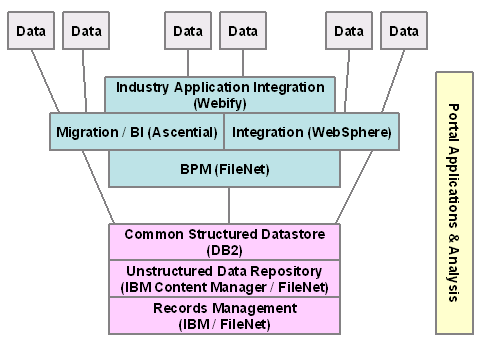
I have no idea if IBM has a formal vision for how all of these pieces look outside of a spending-spree. From a generic systems standpoint, I would see a common architecture a little like this:


This architecture gives IBM the ability to:

  • Orchestrate human and systems processes (BPM)
  • Manage a central integration infrastructure (WebSphere Integrator)
  • Migrate and integrate data to a central datastore (Ascential / DB2)
  • Access a range of industry specific datasources (Webify)
  • Store unstructured data related to business processes (Content Manager / FileNet)
  • Manage information lifecycle of all unstructured (documents) AND structured (systems data) through records retention policies (Records Manager)
  • Present user and analytics applications through a common portal interface
This is a powerful architectural mix that very few (if any) organizations can provide without requiring them to partner with other vendors.

With the FileNet acquisition, IBM gains a foot in the door to many corporations that have problems that they may have been attempting to solve with SOA and BPM in a piecemeal fashion. With the other recent acquisitions IBM could claim the ability to approach these problems in a broader, all encompassing technical approach.

If IBM really pushes this hard we could be about to experience the next generation of organizations bravely attempting massive systems re-engineering exercises, this time with a suite of products from a single vendor. Big Blue will again be the central figure of IT in many organizations.


Technorati tags:

Wednesday, August 09, 2006

Long term document format portability is not important

A post by David Perry on the Freeform Comment blog ODF Debate: A real world view caught my eye. The competitive nature of the Open Document Format and Microsoft's new Open XML format for Office 2007 are discussed.

An interesting point is raised:
We must also remember that Microsoft has serious plans to build a developer community around Office 2007 so, just as with .Net, and Visual Basic, we can anticipate a growing level of support for Open XML from ISVs that is likely outstrip ODF, at least in the short to medium term. If you have an application or service that you think should be integrated with or accessible through an “office like” application, or has the ability to manipulate an office style document, should you build around Open XML and reach 90% plus of the market, or ODF and reach a minority - no-brainer really. Perhaps it ain’t fair, possible it ain’t right, but that’s the real world.

This makes sense for document editing applications. As David also says, setting yourself up for document compatibility problems is unthinkable in a business sense, when you suddenly can't read mission critical documents 25 years after their initial creation. Being able to view documents long-term is essential, and ODF v. Open XML presents a challenge to that.

I look at the problem of document standards over the lifecycle of the document:


The lifecycle works such that the draft, review or 'work in progress' timeline is typically relatively short, compared to the timeline after the point of publishing where, in a well controlled organization the document is made an official record.

ODF and Open XML apply to the document in its 'work in progress' state. PDF/A should be the published format that provides a perfectly repeatable rendition of the document on every view, but does not require further editing.

To my mind the most important task for the work in progress formats (ODF and Open XML) is enabling editing in whichever application the user chooses. That said, early in the document lifecycle, which is fairly short, file format portability is most important only within the limited set of versions of applications available at that time. In an ideal world Open Office should not have to provide support for a MSFT Office format version that is not current. Vice versa, MSFT Office should not have to provide support for an ODF format that is not current. By current I mean with a significant number of users authoring documents. In both cases I am just worried about the editing of work in progress documents, and that happens over a fairly short period of time and therefore with a limited set of available application versions (nobody in the real world uses MS Word prior to v6 to do they?).

After publishing my primary concern as a user is being able to read the document, exactly as published, time after time. PDF/A is the enabling format for this, supported by almost everyone. Whether this will be achieved is a little dependent on whether MSFT gets over its spat with Adobe and just uses PDF/A, rather than Adobe's proprietary PDF format.

This does not mean that organizations do not need the ability to edit published document year in year out. These type of vital documents are handled by retaining an editable version of the document alongside the published version. If the document is edited over time, the portability between tools will remain current and changes to the standard tool used in an organization will be handled by saving to the new format on the next round of editing.


Summary

Document format portability is essential to allow organizations to select their editing application of choice, and to be sure that their partners can collaborate with them in the editing of work in progress documents. The portability of every combination of document format version across every version of the tool is not required, since editing should be over a relatively short period of time compared to the overall document lifecycle.

PDF has been adopted by almost every organization for publishing final documents, so there is no fear that they will not be able to read those document into the future.

The ODF v. Open XML argument for long term viewing of documents is moot: do not rely on document formats designed for editing to provide long term viewing capability - use PDF/A instead.


Technorati tags:

Tuesday, August 08, 2006

Identity theft: banks must start monitoring

Identity theft is a big issue, as we are constantly being reminded by our banks and credit card companies. Some even appear to try and profit from the fear of this problem by offering fee-based monitoring services, often by offering customers a copy of their free credit report as an enticement.

A Bank Systems & Technology article Agencies Issue Proposed Rule on Identity Theft 'Red Flags' reports that US federal banking regulators are proposing new rules requiring banks to perform monitoring of customers' accounts as part of their standard operations:
The proposed regulations include guidelines listing patterns, practices and specific forms of activity that should raise a "red flag" signaling a possible risk of identity theft. Under proposed regulations, an identity theft prevention program established by a financial institution or creditor would have to include policies and procedures for detecting any "red flag" relevant to its own operations and implementing a mitigation strategy appropriate for the level of risk, according to a release from the agencies.

Although it is likely that banks will come back with questions regarding this proposal, an identity theft program seems close enough in appearance to their ongoing anti-money laundering (AML) programs that there will be little additional compliance burden. Specifically, the program as mandated by the Bank Secrecy Act (BSA) requires monitoring for suspicious activity, including specific money laundering 'red-flags'.

It is likely that financial institutions will be able to leverage current technology, or use this event as a driver to invest in appropriate technology, to perform automated monitoring and analysis of transactions and activities to also encompass the identity theft 'red flags'. From the Bank Systems & Technology report:

The proposal lists 31 red flags in connection with an account application or an existing account, including:

  • A notice of address discrepancy is provided by consumer reporting agency.
  • The photograph of physical description on the identification is not consistent with the pearance of the applicant or customer presenting the identification.
  • An account that has been inactive for a reasonably lengthy period of time is used.
  • The financial institution or creditor is notified that the customer is not receiving account statements.
  • An employee has accessed or downloaded an unusually large number of customer account records.

It would surprise me if some of these items were not already included in the AML program. For example, Know Your Customer requires that an institution verifies the identity of new customers. Discrepancies with other sources of information should automatically flag an issue. Not all 'red flags' will apply to every bank, and their risk assessments will help mould the scope of the new compliance program.

James Taylor often blogs about the capabilities of business rules and decision management to address these types of issues. Once in place these systems enable institutions to respond to this type of compliance monitoring rapidly and with minimal incremental cost. These approaches, along with basic monitoring within BPM processes such as New Account Opening could provide everything that is required across a range of identity theft, fraud and AML requirements. Another approach to look at is Aungate, which has examples of background monitoring capabilities.

As with any compliance regulation, the documentation and periodic audit of the program and controls may end up being larger than the effort to actually put it in place. Well designed automated systems reduce this burden by being effectively self-documenting and readily available for audit. A decent document management system, or an enterprise compliance management system (e.g. Certus) will hold all that documentation.

Since it seems that some banks already perform some of this monitoring as a fee-based service, this regulation may purely represent a revenue stream that may be going away soon.

Technorati tags: